
When you plan the music for a family celebration, you quickly realize that it's not just about good songs. It's about generations, expectations, favorite songs, volume, timing and, above all, the mood. This often determines whether an evening goes well - or whether it turns into a party that will be talked about for a long time to come.
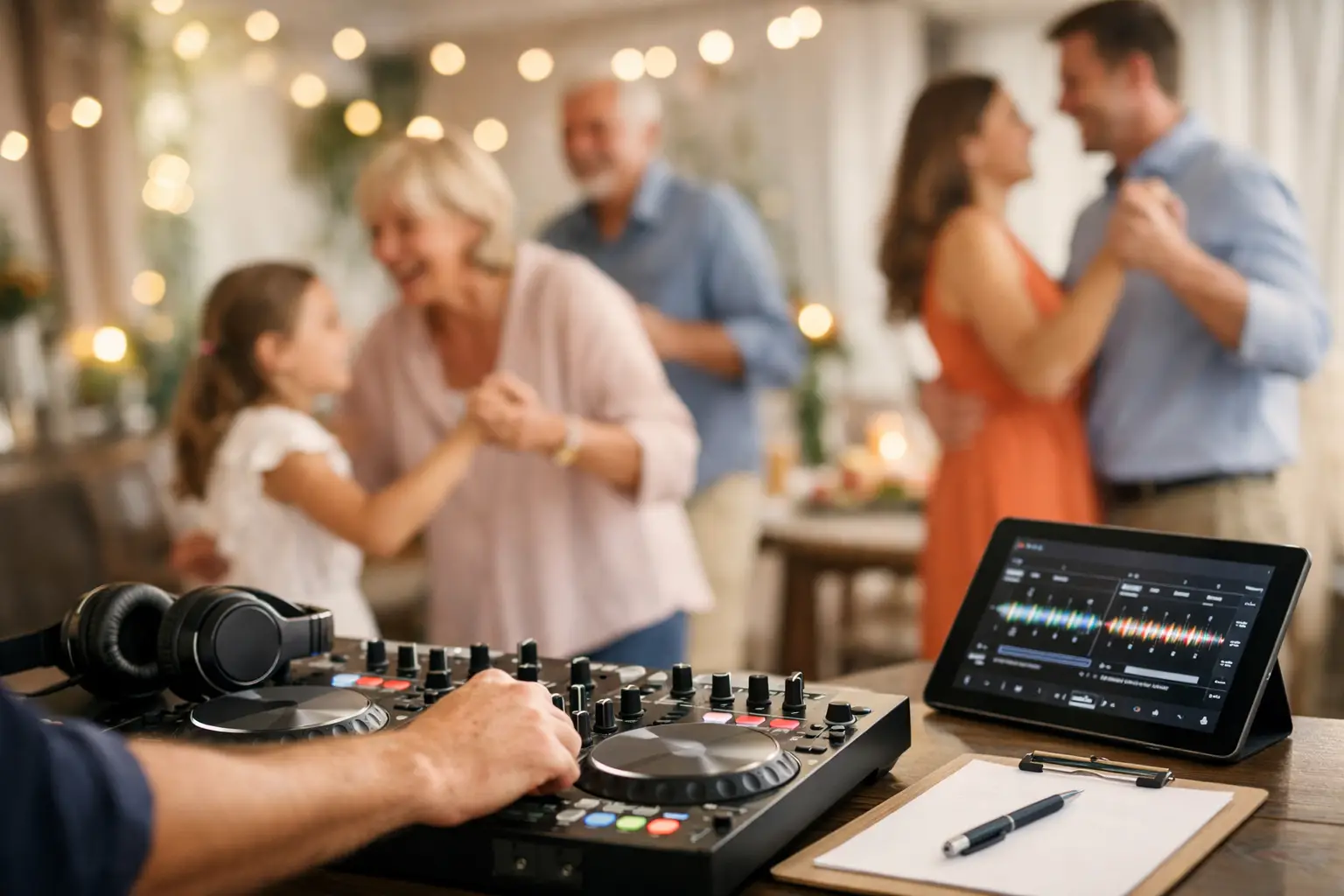
Why music at family celebrations is trickier than expected
A family celebration almost always has a different musical profile than a birthday party with friends or a club night. There are often several generations sitting at the same table. The aunt wants to dance, the grandpa loves evergreens, the younger guests want the latest hits and someone is secretly hoping for hits without saying it out loud.
This is precisely why a random playlist is rarely enough. Music must connect at a family celebration. It shouldn't get too loud too soon, but it also shouldn't stay so staid that the evening never gets moving. The transition from food, conversation, reminiscing and later dancing is the real key.
Those who underestimate this often experience a typical evening: During dinner, something random is playing, later on nobody really knows how to set the mood, and in the end many people stay seated. Not because the guests don't want to party, but because nobody has got the music right.
Planning music for a family celebration - first understand the occasion
Before we talk about specific titles, it's worth asking a simple question: What is the heart of this celebration? A milestone birthday usually needs a different dramaturgy than a Wedding anniversary, a silver wedding anniversary, a confirmation party or a big family celebration with an open end.
For a 60th birthday, the focus is often on shared memories, familiar music and a warm introduction. For an anniversary, it can be more emotional and festive. At a family celebration with many younger guests, the later part of the evening can be much more modern and dance-heavy.
I always advise people not to think in genres, but in moments. What should happen at the reception? How should the food feel? When should the first real round of dancing start? And what music ensures that not just two or three guests but the room as a whole feels energized?
The biggest mistake: only planning for your own taste
Of course there should be room for your favorite songs. After all, it's your party. Nevertheless, music becomes really powerful when it pleases not only the host, but also the audience. At family celebrations in particular, musical generosity is often the difference between a personal celebration and a full dance floor.
That doesn't mean that everything has to be arbitrary. It just means that a good evening is not created by playing 30 songs in a row that exactly reflect your personal taste. It is created when emotional hits, well-known classics and danceable moments are cleverly mixed.
Sometimes a song that you would never listen to yourself at home is just right at a family celebration. Because it triggers memories. Because several generations immediately sing along. Or because it breaks the ice. It's songs like this that give an evening warmth and traction.
How to build up the music over the course of the evening
The best party rarely starts at full throttle musically. Especially at the beginning, guests need space to arrive. Music that creates an atmosphere without disturbing conversations works well at the reception. Soul, relaxed pop classics, subtle lounge elements or well-known mid-tempo songs are often more suitable here than hard breaks or punchy dance tracks.
During the meal, the music should be present but never dominant. This sounds obvious, but is surprisingly often done wrong. If the volume is too high, any conversation becomes tiring. If the selection is too insignificant, the evening lacks character. Good dinner music is tasteful, warm and unobtrusive.
As soon as the program items, speeches or small surprises are over, the energy is allowed to rise slowly. This is not the time for musical experiments, but for reliability. Well-known songs with a clear positive effect often get guests on the dance floor better than songs that are too special.
Later in the evening, things can get bolder. Then groups have found each other, the mood is relaxed and you can switch between classics, 80s, 90s, charts, discofox, hits or party hits much more dynamically, depending on the audience. The only important thing is that this increase seems logical and doesn't suddenly come out of nowhere.
Which music works across generations?
A blanket list would be too simple, because every family is different. Nevertheless, there are a few musical fields that often work well at family celebrations. These include well-known pop and rock classics, disco and soul hits, danceable German songs, selected hits and a good dose of 80s and 90s music.
The crucial point is the dosage. A single hit can open up a room. Ten in a row can lose guests who have no interest in them. The same applies to current charts or electronic tracks. What goes well at a younger party may be too special too soon at a family celebration.
Very often, it's not the most modern set that wins, but the smartest. Songs that many people know create a connection. Songs that only appeal to a small group need the right timing. This is exactly where experience comes in.
Wish songs yes - but please with a system
Wish music is part of many family celebrations. It's nice because guests feel seen. But it can also backfire if every spontaneous idea is played immediately. Then the evening loses its thread.
It makes sense to make a clear pre-selection. Consider in advance which songs are essential for you, which no-goes there are and which music genres are generally desired. This creates a framework in which wishes remain possible without the mood falling apart.
A small must-play list with perhaps ten to fifteen titles that have real emotional significance is particularly helpful. It is also worth making a short please-don't-play list. This avoids misunderstandings and makes planning much more relaxed.
Playlist or DJ - which is better for a family celebration?
To be honest, it depends on the size, requirements and schedule of your party. A self-created playlist can work well for smaller, relaxed celebrations if no one has specific expectations regarding moderation, transitions, dynamics or flexible music requests. It is cheaper, but also more rigid.
As soon as several generations come together, program items need to be coordinated or the evening needs to flow safely into a good party, an experienced DJ often makes all the difference. Not just because of the music itself, but because of the timing, the reaction to the room and the ability, to really read the mood.
A playlist often looks good on paper. In practice, it doesn't realize when the audience needs more energy, a style isn't working or a special moment should be carried musically. A good DJ can start right there and keep the evening lively.
If you don't want to leave a celebration to chance, you benefit from this security. At https://djgerreg.de you can see how important personal coordination, experience and a keen sense for full dance floors.
Often underestimated: volume, technology and sense of space
Even the best choice of music loses its impact if the technical implementation is not right. Music that is too loud during dinner is annoying. Too weak sound on the dance floor slows you down. Poor microphones make talking tiring. And if loudspeakers are positioned awkwardly, the whole room seems unsettled.
Family celebrations in particular often require a sure instinct. The room, the number of guests, the seating arrangement and the room acoustics have a huge influence on how the music is received. That's why you should not only ask what is to be played, but also how it should work in the room.
A professional set-up ensures that music has its place in every phase of the evening. Pleasant during the meal, clear during speeches and powerful enough when people are dancing. It sounds technical, but in the end it is something very emotional: people feel more comfortable and celebrate more freely when the setting is right.
How to turn music into real atmosphere
Mood is not created by volume or the longest playlist. It is created when people feel picked up. When the first song comes at the right time. When older guests are not excluded. When younger guests still get their moment later on. And when the music never works against the party, but carries it.
That's why planning the music is not a minor matter. It is one of the most important building blocks of the whole evening. If you think with feeling, experience and a clear sequence, you create memories instead of just sound.
In the end, your family celebration doesn't have to sound perfect like a festival. It should feel just right. That's when guests go home with a smile, talk about the evening for weeks to come and remember not just the food or the decorations, but that special feeling of having celebrated together.
Book DJ GerreG now & secure your desired date in good time
Are you planning your wedding or another party?Then secure your DJ early! I'll be happy to accompany you from the planning stages to the last encore in the early morning hours. I'm really looking forward to your message! 🎶

🎧 More from DJ GerreG
👉 Website:
https://djgerreg.de
🎧 Spotify:
https://djgerreg.de/spotify
📸 Instagram:
https://instagram.com/djgerreg
Play button YouTube:
https://www.youtube.com/@DJGerreG
🛒 Buy songs (before release):
https://gmusiqrecords.de/shop