If an image film looks good, the website has a strong impact, and in the end, any random track is put underneath, you immediately feel the disconnect. That's exactly where this Music Production for Brand Identity Guide Because your brand's sound isn't a nice-to-have, but often the part that makes mood, attitude, and recognition tangible in the first place.
Many companies invest a lot of money in logos, colors, photos, and text – and then treat music like wallpaper. That's a mistake. Music helps determine whether your presentation appears high-quality, approachable, modern, exclusive, or interchangeable. Especially for events, trade show appearances, social media clips, image videos, or podcast intros, the right sound makes a difference that you don't just hear, but feel deep down.
Why music for brand presence is more than just mood
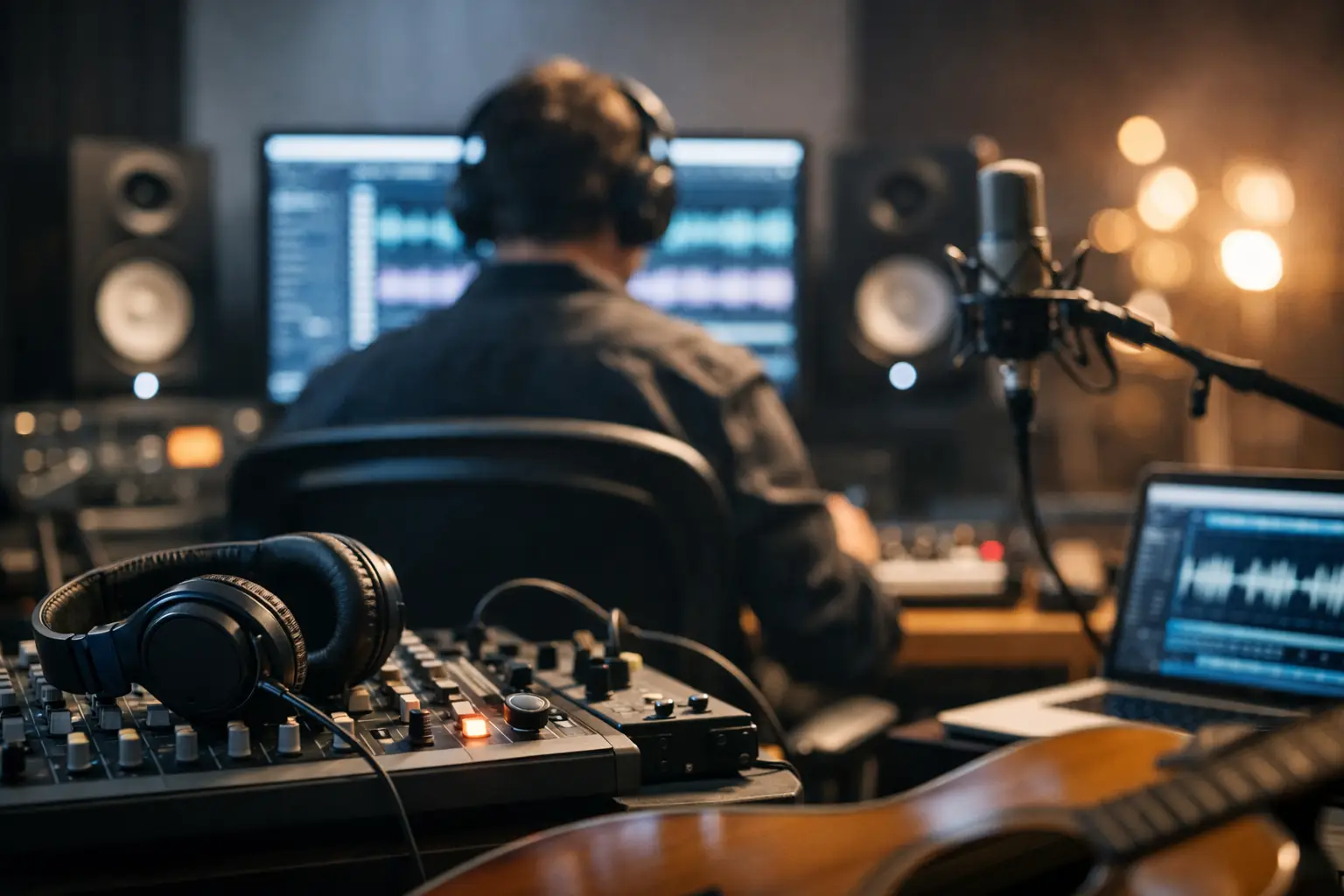
Music conveys in seconds what other media take much longer to achieve. A beat can send dynamism, a piano theme trust, a warm groove closeness. That's precisely why professional music production for brands doesn't work on the principle of "as long as it sounds nice.".
A strong brand presence requires consistency. If your company wants to represent reliability, quality, and personality, this must also be reflected in its sound. Otherwise, the surface may match, but the feeling behind it is off. People notice such inconsistencies faster than many believe.
Just now at company parties, This is crucial for product presentations or high-quality customer events. It's not just about making sure something runs. It's about making sure your audience feels who you are and how professionally you work from the very first moment.
Music Production for Brand Identity Guide – What Needs to be Clear First
Before a single sound is produced, you need a clear answer to a simple question: How should your brand sound? Not theoretically, but very practically. Should it sound elegant, emotional, urban, minimalist, energetic, or rather relaxed and trustworthy?
Many skip this step and immediately talk about genres. This often leads in the wrong direction. Because a company doesn't have to be „pop“ or „house“. It needs a sound character that fits the target audience, the occasion, and the image.
A company with regional roots in craftsmanship usually needs a different sound than a technology company with international ambitions. A hotel brand operates differently than a fashion label. And a company party can sound more emotional and broad than a brand film for a factual B2B appearance. So it always depends on where the music is used.
The three questions before every production
In my practice, it's always apparent: Good results are achieved when three things are clearly defined beforehand. First, the intended use. Is it for an event intro, social media, an exhibition stand, a podcast, or a corporate film? Second, the target audience. Should the sound persuade decision-makers, emotionally engage guests, or activate a younger community? Third, the brand perception. What attitude should be audible?
If these points remain unclear, the music often becomes arbitrary. It may sound technically sound, but it won't fulfill its actual purpose.
The biggest mistake: Stock music as a quick fix
Naturally, pre-made music can work in some cases. Not every project immediately needs an individual composition. But anyone who really wants to sharpen their brand image will quickly hit limits with standard tracks.
The problem isn't just the lack of exclusivity. It's also the lack of precision. A track from a database wasn't built for your story, your timing, and your brand impact. It's a compromise. Sometimes that's good enough. Often, you can hear it.
It becomes particularly delicate when companies want to present themselves as high-quality but cut corners on music. Then the presentation appears visually strong and acoustically generic. This gap causes more damage than many suspect.
Individual Music Production This has clear advantages. You get length, dramaturgy, instrumentation, and energy precisely matched to your usage. Most importantly, something unique is created. And that's exactly what makes brands strong.
This is how you create a sound that truly fits your brand
At the beginning, there isn't a technical topic, but rather listening. Good music production starts with a briefing that not only collects superficial wishes, but truly understands your performance. What imagery do you use? How do you speak with clients? What mood should be created at an event? Where do you want to stand out from the competition?
Then it's time for the musical translation. Tempo, instruments, rhythm, timbres, and dynamics are not chosen randomly. A reduced, elegant sound can convey quality and tranquility. Electronic elements can emphasize modernity and precision. Organic instruments create closeness and humanity. Silence and space also play a role. Not every brand needs constant pressure.
It's important not to chase every trend. What sounds modern today can seem old in a year. A good brand sound can be current, but shouldn't rely solely on short-term effects. Otherwise, it quickly loses value.
Brand music doesn't have to be complicated
Many clients immediately think of huge budgets or endless coordination when they hear "custom production." In practice, this doesn't have to be the case. If the goal, mood, and intended use are clearly defined, it's possible to work very efficiently.
Often, a strong main theme, a clean short version, and perhaps variations for different applications are enough. What's crucial isn't quantity, but recognizability. A good audio branding It doesn't have to be overloaded. It has to fit.
Where professional music production pays off particularly well
The benefit always emerges where brand and emotion come together. This is particularly noticeable at events. The musical opening to an awards ceremony, a corporate event, or a product presentation immediately sets the tone. Within seconds, it's clear whether an evening is starting generically or if a professional performance with character is being created.
The effort is also worthwhile in the digital realm. Social media reels, commercials, or short company videos thrive on speed and recognition. If every video sounds different, a clear brand image won't emerge. Consistent sound ensures that content belongs together – even when it's published on different platforms.
Podcasts are another good example. Intros, interstitials, and outros seem small but have a massive impact on the first impression. Especially where trust is to be built, a unique sound pays off.
And then there's the live aspect. Those who think about music production and event practice together can create much more cohesive transitions between brand films, stage moments, and parties. This is precisely where a major difference lies between purely studio-based thinking and actual event experience.
What a good producer should bring to your brand's appearance
Not everyone who can produce beats automatically understands brand impact. For companies, technical skill is not enough. You need someone who can connect emotion, timing, target audience, and context of use.
A good producer, therefore, doesn't just ask about favorite songs. They want to know who your audience is, how your performance comes across, and what atmosphere you want to create. They also recognize when less is more. Because not every production has to be loud, epic, or maximally attention-grabbing. Sometimes, the sound gains precisely through restraint.
Experience with actual events is also helpful. Those who have experienced how music affects people in a room produce differently. Practice beats theory. This is especially true for dramaturgy, length, building tension, and transitions. DJ GerreG This precise combination of event experience and studio work is a crucial advantage.
What you should prepare before making an inquiry
If you want to have music produced for your brand presence, you don't have to be an expert. But you'll save time and get better results if you sort out a few things beforehand.
Describe your occasion as concretely as possible. Don't just say it should sound modern, but what the music is intended for and what effect you want to achieve. Gather examples of moods, not just songs. And honestly consider whether you need subtle background sound or a real recognition factor.
Your schedule is just as important. Good production requires coordination, even if processes can run lean. Anyone who realizes two days before an event that their own sound is still missing usually compromises quality unnecessarily.
In the end, it's not just about music
The best brand sound isn't the most complicated or the most expensive. It's the one that fits you, emotionally connects with your audience, and credibly enhances your performance. When music achieves exactly that, accompaniment becomes impact.
And that's precisely why it's worth giving listening the same attention as seeing. People forget slides, individual phrases, and some details. But they remember astonishingly well the feeling a performance evoked in them.
Book DJ GerreG now & secure your desired date in good time
Are you planning your wedding or another party?Then secure your DJ early! I'll be happy to accompany you from the planning stages to the last encore in the early morning hours. I'm really looking forward to your message! 🎶

🎧 More from DJ GerreG
👉 Website:
https://djgerreg.de
🎧 Spotify:
https://djgerreg.de/spotify
📸 Instagram:
https://instagram.com/djgerreg
Play button YouTube:
https://www.youtube.com/@DJGerreG
🛒 Buy songs (before release):
https://gmusiqrecords.de/shop