When a program item is announced too late, the microphone whistles, or the transition from speech to dance seems awkward, you immediately notice how crucial good timing is at an event. That's precisely why it's worth, Combining event moderation with a DJ not to be seen as just a nice added benefit, but as a real quality factor for the whole evening.
Many organizers book music first and then take care of announcements, scheduling, and microphone management. In practice, this often leads to friction. Who speaks when? Who starts the entrance music? Who introduces the speech without ruining the moment? And who maintains the energy in the room when the program changes? When the DJ and moderation come from a single source, many individual building blocks become a coherent process with feeling, pace, and confidence.
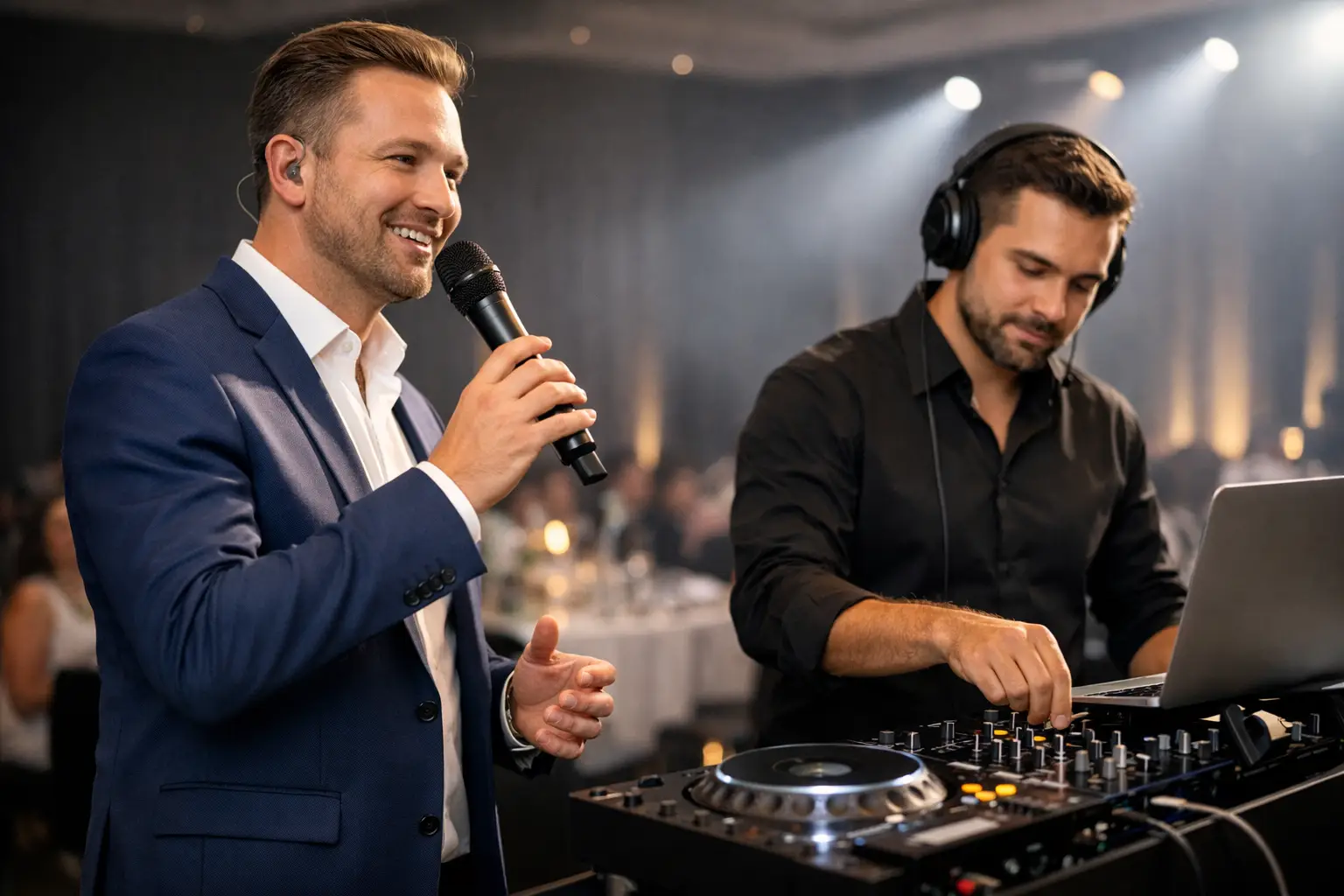
Why combining event hosting with a DJ makes sense
Music is never just background. It controls emotions, tension, and dynamics. Moderation, in turn, provides direction, creates connection, and maintains the common thread. Booking both separately can work. But it requires more coordination, more timing accuracy, and more communication between different service providers.
Clear advantages arise when the same person leads through the evening both musically and as a moderator. Transitions become more precise because no information is lost. The right song starts at the right moment because no additional coordination via radio or shout is necessary. At the same time, addressing the audience in the room remains natural because music and words come from the same feeling for the audience and the situation.
This is especially valuable for weddings, corporate events, and anniversaries. These events thrive on emotional moments, but also on a relaxed flow. No one wants to feel like they're stuck to a tightly scheduled program. It should feel effortless, even though a lot of experience is working behind the scenes.
Events where event moderation with a DJ is particularly worthwhile
The advantage is most clearly demonstrated at celebrations with multiple program points. A wedding is the best example. Here, the reception, meal, speeches, first dance, cake, surprises, and party often alternate in quick succession. If someone is then needed who not only plays music but also hosts these phases in a likeable way, it creates security for the bridal couple and peace of mind for the guests.
Company celebrations also benefit greatly from this. At a Christmas party, summer party, or anniversary, speeches, awards, show acts, and relaxed party phases need to flow seamlessly. The moderation should be neither too stiff nor too personal. An experienced event DJ with moderation skills can strike exactly the right tone – professional, clear, yet approachable.
For birthdays, silver anniversaries, or larger family celebrations, things often get a bit more personal. Less show and more sensitivity are needed here. Announcements should help, but not dominate. This is also an important point: good moderation doesn't mean talking as much as possible. Good moderation means saying the right thing at the right moment.
When a separate solution can still be sensible
As clear as the advantages are, there are also cases where separate moderation is the better choice. For very large galas, trade fairs, or stage productions with complex scripts, multiple guests on stage, and a high level of editorial content, a specialized host is often advisable. The focus there is less on party flow and more on presentation, conducting interviews, or formal stage presence.
Even for international events, the languages, protocols, and event format in demand can be important. Then, it should be openly examined whether a DJ with moderation is sufficient or if two professionals would be a stronger combination. It's not about pushing a solution at all costs. It's about finding the right solution for your event.
This is how moderation works really well at an event
Many people think of moderation first in terms of grand pronouncements or constant announcements. The opposite is usually better. Especially at parties, moderation works best when it is brief, friendly, and to the point. A cleanly announced wedding dance, an appreciative transition to a speech, or a charming invitation to the dance floor are often sufficient.
What's crucial is the attitude behind it. Someone moderating needs to be able to read the room. Are the guests deep in conversation? Is an emotional moment approaching? Does the group need a boost or more calm? This assessment isn't a canned phrase; it's a matter of experience.
As a DJ with hosting duties, you also have the advantage that the music doesn't compete with the words. The volume is kept at the right level, the microphone is ready, and sound effects are hit precisely. This might sound like a given, but in reality, it's often the exact difference between average and truly professional.
Combining Event Moderation with a DJ – What to Consider When Booking
If you're looking for this combination, you shouldn't just ask if someone can hold a microphone. How they moderate is much more important. Does the address sound natural? Does it fit your occasion? Does it seem staged, too loud, or too showy? Every celebration has its own character, and the moderation must support that character.
Also pay attention to how the preparation goes. A good DJ with hosting skills will want to know which program items are planned, who is speaking, which names need to be pronounced correctly, and which moments are particularly important. That's where professionalism shows. Not just on the evening itself, but long before in the coordination.
The technical side is just as important. Wireless microphones, sensible levels, clear voice intelligibility, and a plan for spontaneous changes are part of this. Because at real events, nothing ever goes exactly according to plan. A speech might be moved, a surprise might be added, or the dance session might be moved up. Then you need someone who stays calm and can still confidently manage the proceedings.
The biggest advantage: less coordination, more feeling.
Many underestimate how much energy is lost in coordinating various stakeholders. When the moderator, DJ, best man, venue, and organizer have to exchange information simultaneously, small gaps quickly arise. Guests immediately notice exactly these gaps – even if they can't name them.
When both are sensibly combined, the evening becomes calmer and livelier at the same time. Calmer in organization, livelier in effect. Because someone who feels the same rhythm musically and in terms of moderation can pick up on and guide moods much more directly. This is not a show effect, but lived event practice.
This makes a huge difference, especially at emotional celebrations. A touching first dance, heartfelt applause after a speech, the perfect moment for the first party song – all of this requires timing. And timing doesn't happen by chance, but through experience, attentiveness, and the ability to read people.
How personal the moderation should be
There's no one-size-fits-all solution here. Some couples only want a few announcements and otherwise want the celebration to work primarily through music, atmosphere, and natural dynamics. Others want more guidance because many guests come from different groups and a clear thread helps.
It's similar for company parties. Sometimes the focus is on casual conversation, other times a more serious tone is needed. The crucial thing is that the moderation never feels out of place. It has to suit you, your guests, and the occasion.
That's exactly why a personal introductory meeting is so important. It quickly shows whether the chemistry is right and whether someone understands how your evening should sound, feel, and give off a vibe. Experience alone isn't enough. It also needs to fit your style.
A good evening turns into a memorable evening
Music can do a lot. It brings people together, evokes emotions, and fills the dance floor. Moderation can also do a lot. It provides security, connects program points, and ensures that important moments don't just disappear. It becomes truly powerful when the two don't run alongside each other, but rather intertwine.
This is exactly what an experienced event DJ stands for – someone who doesn't just press play, but takes responsibility for the atmosphere and the flow. When I combine music and hosting at a party, it's never about putting myself in the spotlight. It's about guiding your evening so that it becomes effortless, lively, and special at precisely the right moment.
So, if you're planning to combine event moderation with a DJ, don't just think about convenience. Think about impact. Because it's often not the loudest program points that are remembered, but the moments when everything just fits together.
Book DJ GerreG now & secure your desired date in good time
Are you planning your wedding or another party?Then secure your DJ early! I'll be happy to accompany you from the planning stages to the last encore in the early morning hours. I'm really looking forward to your message! 🎶

🎧 More from DJ GerreG
👉 Website:
https://djgerreg.de
🎧 Spotify:
https://djgerreg.de/spotify
📸 Instagram:
https://instagram.com/djgerreg
Play button YouTube:
https://www.youtube.com/@DJGerreG
🛒 Buy songs (before release):
https://gmusiqrecords.de/shop