If you are looking for a Sample music mix for an international wedding When you're looking for [something], it's rarely just about good songs. It's about tact. Because at an international wedding, it's not just different musical tastes that meet, but families, cultures, languages, and expectations. That's exactly why a playlist doesn't work according to a standard formula. It needs to connect, not just generate noise.
I experience it again and again: The best atmosphere isn't created when only one style is pushed through. It's created when as many guests as possible feel catered to at some point in the evening – without the dance floor fragmenting into many small musical islands. Therefore, a good mix has heart, dramaturgy, and timing.
Example Music Mix for an International Wedding: Here's How It Should Be Structured
An international wedding needs more than a colorful song list. The order is crucial. If you jump straight into jarring transitions – first German Schlager, then Balkan, then R&B, then Salsa – the evening can quickly feel chaotic. Good DJs build bridges. They read the mood, use familiar titles as anchors, and gradually guide guests into different worlds.
A simple thought can help with this: not every nationality needs the same share, but every important group of guests should get their moment. That's a big difference. For example, if a German-Italian wedding is being celebrated and there are many guests on both sides who love to dance, the music from both cultures should be clearly audible. On the other hand, if there are international guests from five countries, with smaller numbers from each, it's often better to focus more on globally known party classics and strategically incorporate individual cultural highlights.
The evening needs phases, not random selection.
A strong music mix doesn't just start at the party. The reception already sets the first tone. Relaxed, stylish songs are ideal here, which are internationally understandable and don't drown out conversations. Soul, light pop classics, acoustic versions, and subtle lounge tracks often work better than strong cultural statements too early in the evening.
The dinner can get more emotional, but not heavy. Many couples make the mistake of wanting to cram all their favorite songs in here. The meal needs space. Music should support, not dominate. International standards, romantic ballads in multiple languages, and warm classics create atmosphere without pulling people away from their tables.
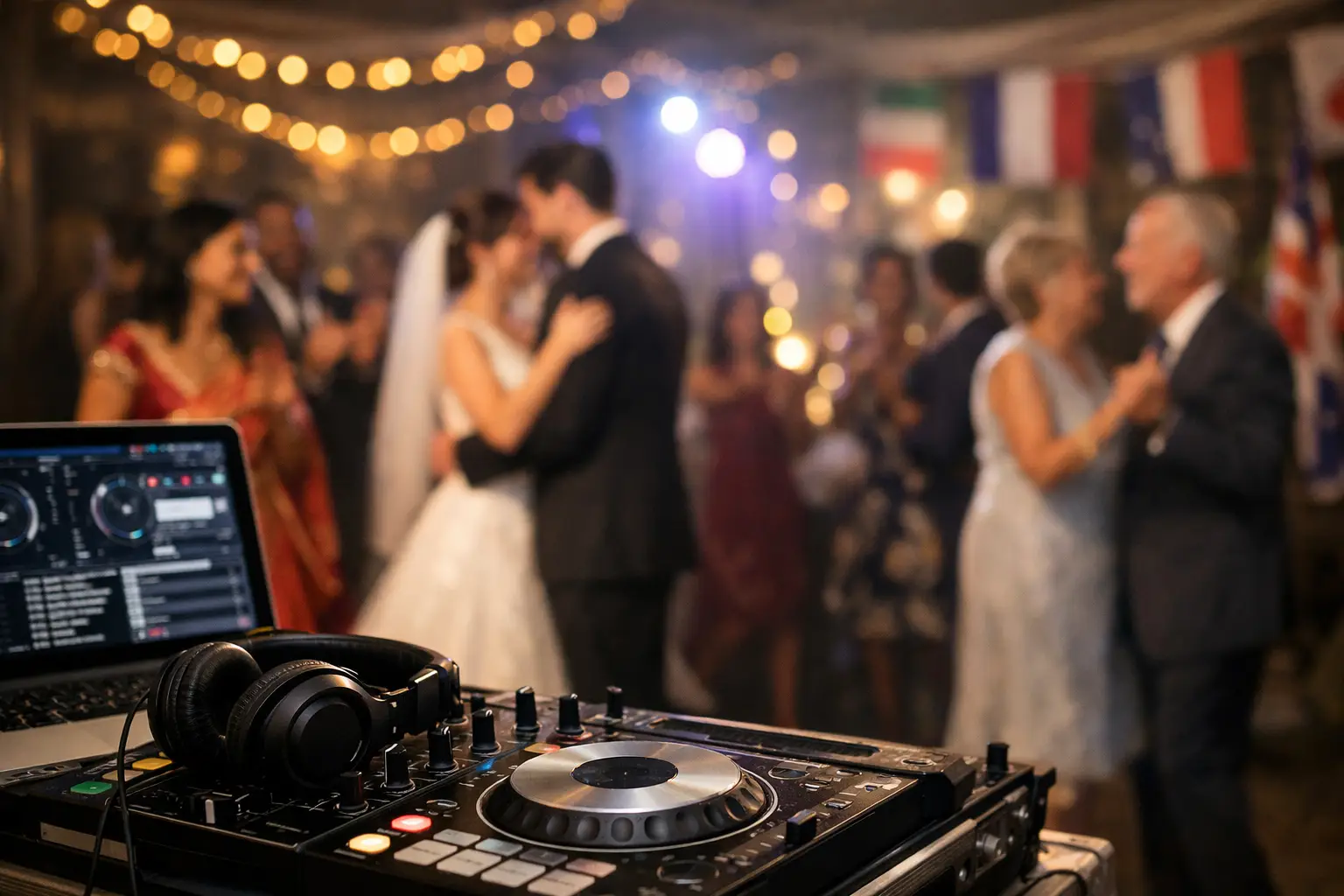
As soon as the party starts, everything changes. Then the music needs clear energy. The first dance is the emotional trigger for that. After that, the transition has to be right. Anyone who picks the wrong song here often loses valuable minutes. That's why I like to work with well-known tunes after the wedding dance that work across generations. Only when the dance floor is noticeably packed is it worth making a bold switch to more culturally specific directions.
A concrete example of an international wedding evening
Let's consider a wedding with German, English, Italian, and some guests from the Arab world. The goal is not to cater to every culture mathematically equally. The goal is to create a shared celebration where everyone feels included.
An elegant mix of light pop music, soul, and international classics is suitable for the champagne reception. Songs by Ed Sheeran, Sade, Michael Bublé, or Eros Ramazzotti can work wonderfully here. They create a sense of closeness without being too overpowering.
During dinner, the music can remain melodic and high-quality. Italian love songs, quiet international pop, a touch of French chanson flair, or soulful ballads in English and German will give the evening character. It's important that the music stays in the background and doesn't become the main topic at the table.
After the opening dance, the real work begins. Now you need songs that everyone knows or immediately understands. Earth, Wind & Fire, ABBA, Whitney Houston, Backstreet Boys, Madonna, Bruno Mars, or Robin S. are such reliable bridge-builders. They bring different age groups onto the dance floor and build confidence for the rest of the evening.
Only then can the mix become more international. Italian party hits, well-known Arabic rhythms, international dance classics, 90s tunes, Latin pop, and current charts can now be integrated much better. Why? Because at this point, the guests are no longer checking if the next song exactly matches their taste. They're already in the zone. And that's precisely the difference between a good playlist and a full dance floor.
Example music mix for an international wedding by genre and effect
When you plan yourself, it helps to think not only in countries but also in effects. There are songs that connect. There are songs that immediately activate a specific group. And there are songs that are strong as cultural highlights but can stop the flow at the wrong time.
Connecting songs are great pop, disco, soul, and party classics. They often work across languages. This includes tracks where guests don't have to think for long. The chorus is catchy, the beat is clear, and inhibitions drop.
In contrast, energizing cultural songs are much more targeted. An Italian classic, a Greek dance song, a Turkish party track, or a Balkan hit can instantly lift the mood – if the right group is ready. However, if it comes too early or without preparation, other guests are more likely to stand aside.
That's why the mix is so important. A strong international wedding thrives on alternating global hits and cultural highlights. Not minute by minute, but with feeling. For example, three to five well-known party tracks, then a strategically placed cultural moment, followed by a broad opening again. That's how the space stays alive.
What bride and groom at the Music selection often underestimated
Many couples understandably focus on their favorite music. That's completely understandable from an emotional standpoint. Nevertheless, a wedding isn't a car ride for two. It's a shared celebration for people with very different energy levels. A song you love isn't automatically a good party track.
Another point is the generational aspect. An international wedding doesn't just mean multiple countries of origin. It usually also means multiple celebration cultures. The older generation might want to celebrate with danceable and classical music, while friends are expecting charts, house, or hip-hop. Both are legitimate. The solution lies in clever programming, not in an either/or.
Wish lists are also often conceived incorrectly. A long list of 80 songs might seem helpful at first glance, but in practice, it's often too rigid. Clear guidance is better: Which 10 to 15 songs are absolute favorites? Which genres absolutely must be included? What are the absolute no-gos? Everything else should remain flexible so the evening can breathe.
This is how you create a music mix that truly suits you
It always starts with the question: Who is actually celebrating with you? Not theoretically, but concretely. How old are the guests? Which cultures are truly strongly represented? Who tends to dance a lot based on experience? Are there traditions, fixed program points, or families for whom certain music is particularly emotionally important?
After that, it's about weighting. A German-Spanish wedding with many dance-loving Spanish guests naturally needs more Latin energy than a predominantly German celebration with a few international friends. Both are correct. It's not about political balance, but about real impact in the room.
Then comes the bracket. What music connects everyone? Mostly, these are well-known pop and party classics, 80s, 90s, 2000s, disco, soul, and select current hits. This foundation provides security. Cultural highlights can be cleanly built upon it.
This is precisely where the strength of an experienced wedding DJ shines. A good DJ doesn't just play songs. They observe when a style works, when the energy shifts, and when a group needs their moment. A static playlist can't do that. Spotify playlist perform. Especially for international weddings, this experience often determines whether the evening is pleasant or unforgettable.
Between desired music and the dance floor lies experience
There are evenings when a bold genre change makes the party explode. And there are evenings when the exact same change empties the dance floor. This depends on the time, the audience, the alcohol level, the age mix, and the mood. That's why an example music mix for an international wedding is always just a guideline, never a rigid recipe.
If you want to be safe, plan not just music, but impact. Think in moments: Arrival, closeness, the first smile, a shared start, cultural highlights, peak time, the final block. This creates an evening where your guests don't split into groups, but remember together.
When music brings people from different countries, generations, and habits onto the same dance floor, that's exactly what makes an international wedding special: diversity becomes connection. And that's where the magic of a truly unforgettable wedding evening begins.
Book DJ GerreG now & secure your desired date in good time
Are you planning your wedding or another party?Then secure your DJ early! I'll be happy to accompany you from the planning stages to the last encore in the early morning hours. I'm really looking forward to your message! 🎶

🎧 More from DJ GerreG
👉 Website:
https://djgerreg.de
🎧 Spotify:
https://djgerreg.de/spotify
📸 Instagram:
https://instagram.com/djgerreg
Play button YouTube:
https://www.youtube.com/@DJGerreG
🛒 Buy songs (before release):
https://gmusiqrecords.de/shop