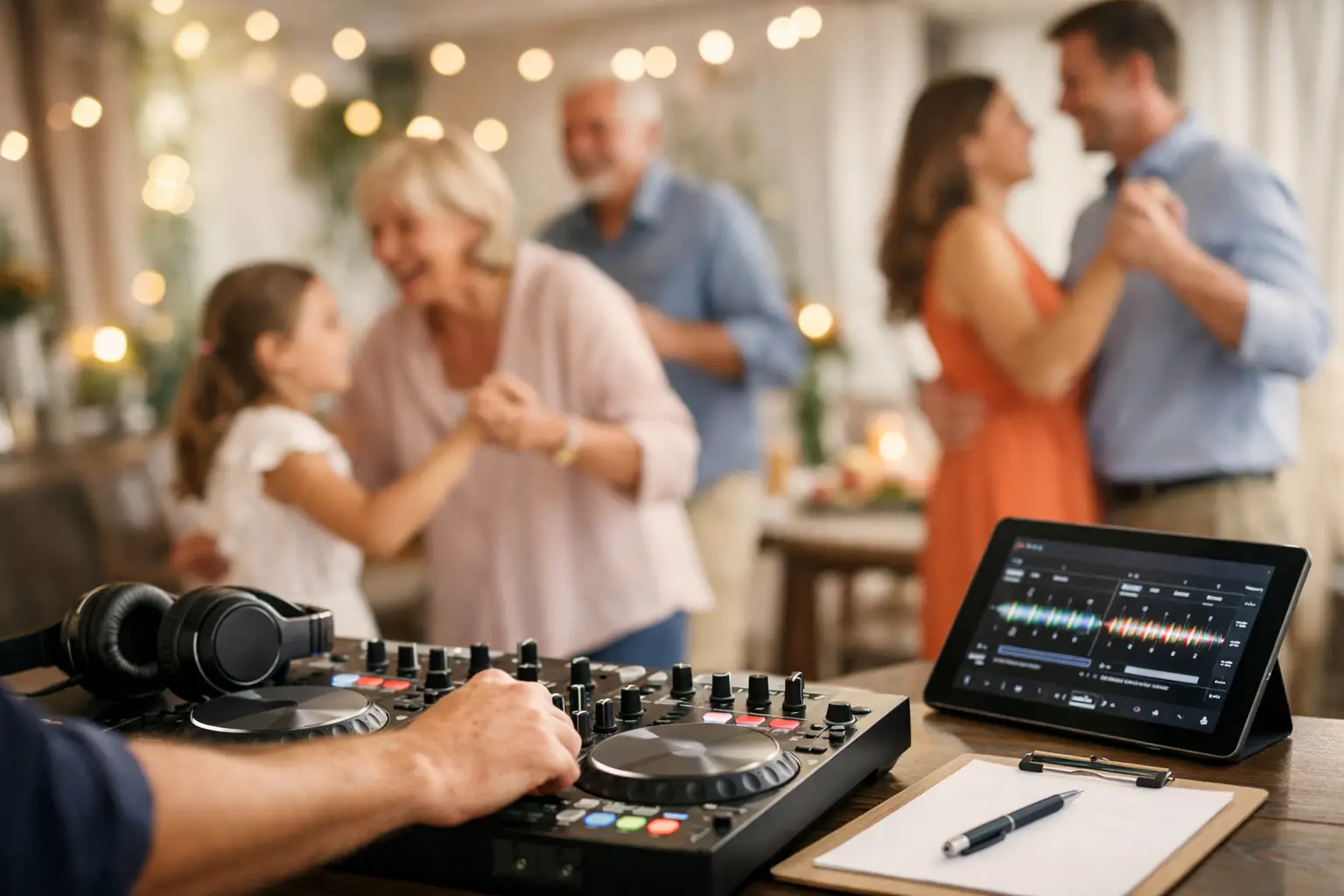
Make the dance floor at the family party lively – When everyone is sitting down amicably at a family celebration, eating nicely, and no one really wants to make the first move onto the dance floor, the mood often sours faster than you'd think. This is exactly where it becomes clear how important it is to actively shape a family celebration's dance floor – not with pressure, but with feeling, experience, and the right intuition for people, generations, and the moment.
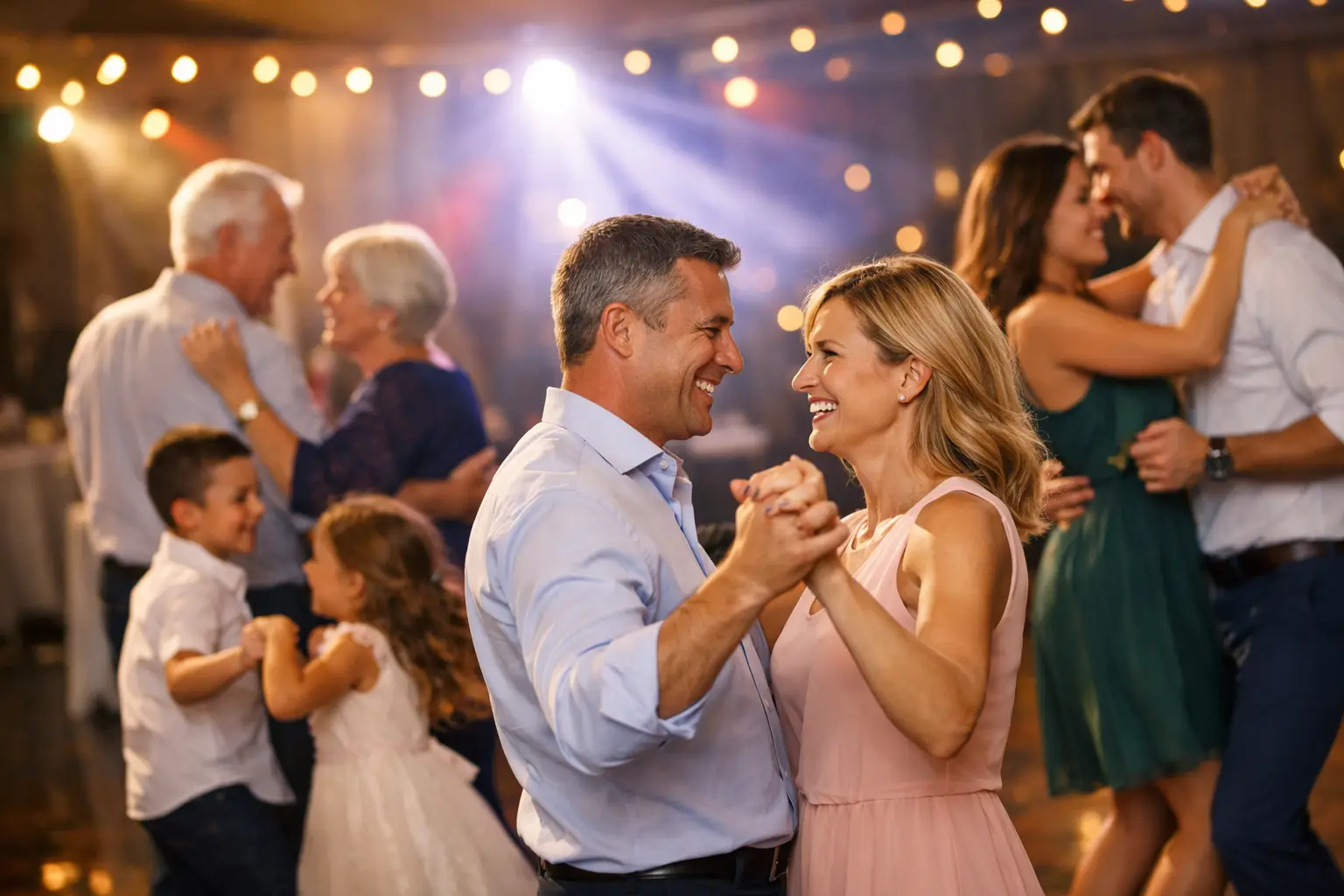
Making the family party dance floor active – what really matters
A full dance floor rarely happens by chance. At family celebrations, children, parents, uncles, aunts, grandparents, and friends sit together in the room. That's precisely what makes the evening special – and at the same time, more challenging than many think. What works for a birthday party with only guests of the same age can completely fall flat at a milestone anniversary or a large family celebration.
Anyone planning a family celebration shouldn't see the dance floor as just a nice extra, but as the emotional centerpiece of the evening. That's where the memories are made, the ones that will be talked about later. Not about how neatly the napkins were folded, but about how three generations suddenly danced together to a song.
For this to succeed, it requires two things above all: a good arc of tension and Music that connects. Many hosts make the mistake of either wanting to force the dance floor too early or leaving it to chance. Both cost energy. A good party develops. It needs momentum, but also guidance.
The right start decides the rest of the evening.
The first few minutes on the dance floor are often the hardest. If the start is a bit bumpy, many guests prefer to stay seated. If, on the other hand, the beginning feels easy, pleasant, and inviting, movement happens almost on its own.
That's why the opening isn't a detail. Especially for family celebrations, it should be a conscious choice. A song that suits the occasion and emotionally connects with multiple age groups is usually more impactful than a current club track with a lot of bass but little recognition value. The goal at the beginning isn't to ignite the wildest party minute of the evening. It's about breaking down inhibitions.
In practice, titles that are well-known, positive, and immediately understandable often work well. Music with choruses that people know. Songs where the first reaction isn't uncertainty, but a smile. The rest builds on that.
If you want to make a family celebration dance floor active, don't think in terms of genres first, but in terms of accessibility. The first musical impulse must build bridges, not draw boundaries.
Why cross-generational music is so crucial
At family gatherings, musical tastes collide that rarely sit in the same room at the same time in everyday life. That's precisely why a rigid style almost never works for several hours. Those who only rely on Schlager often lose the younger generation. Those who only play modern and urban music won't reach the older generation. Those who exclusively want to push their personal favorite music risk an empty dance floor.
The better solution is an intelligent mix. The key isn't to play as much as possible, but to find the right order. An evening can start with classics, become more danceable and modern later, and incorporate familiar songs along the way that can get even skeptical guests back on the dance floor.
That's where experience comes in. Good music planning isn't about having a long playlist. Good music planning is about being able to read people. Even after a short time, I can often tell if a table responds better to disco fox, if the younger crowd is into 90s music, or if the family is singing along loudly to German evergreens. This dynamic is more decisive than any pre-written wish list.
The dance floor needs guidance, but not coercion.
Many hosts wonder if they should invite guests to dance directly. The honest answer is: it depends. A casual, charming invitation can work very well. Too much pressure, on the other hand, quickly creates rejection.
Tact is especially important at family celebrations. Not everyone wants to be the center of attention right away. Some just need a little nudge, others are waiting for a few brave souls to start. That's why the dance floor should be set up in a way that makes it inviting, not like a test situation.
This starts with the effect of the space. A dance floor that is in the middle of the action and doesn't feel like a neglected area on the side is automatically better received. Lighting also plays a role. Too bright often seems stiff, while too dark can be inappropriate for family celebrations. Pleasant, warm party lighting creates atmosphere without singling anyone out.
Even more important, however, is the timing. Immediately after an emotional program item or while guests are in deep conversation, even the best song will fall flat. After the meal, after a brief moment to gather, and with a clear musical invitation, the readiness is significantly higher.
Small groups bring big movement
A dance floor rarely fills up all at once. It usually starts with just a few people. That's precisely why the focus shouldn't be on mobilizing everyone immediately. It's enough if the right small group gets up first.
These are often siblings, cousins, the anniversary couple, close friends, or the core intergenerational group that emotionally carries the evening. When these guests have fun, others follow more quickly. A half-full dance floor with genuine joy is more impactful than a full one where people were reluctantly sent.
This shows how valuable personal coordination is before the celebration. Who are the drivers in your family? Who likes to dance? Who gets others involved? Such information may sound small, but in practice, it makes a huge difference.
Mistakes that often ruin the mood at family gatherings
The most common mistake is musical randomness. Simply playing any mix without paying attention to reactions takes away any direction from the evening. Guests notice very quickly whether the music is leading the room or is just background noise.
Another point is the incorrect volume. Too loud in the early phase blocks conversations and creates resistance. Too quiet in the party phase drains energy from the dance floor. Volume is not a constant state, but a tool.
Too many program items can also dampen the mood. If speeches, games, surprises, and interruptions chop up the evening, it's hard to get a real flow going. Of course, emotional contributions can have their place. But a strong family celebration needs room to celebrate. Otherwise, the dance floor will never really get going.
And then there's the desire to please everyone at the same time. That sounds nice, but it's often the quickest path to mediocrity. Not every song will excite every guest. It doesn't have to. What's crucial is that as many people as possible feel engaged throughout the evening, repeatedly.
This is how to create real atmosphere instead of a mandatory program
The best family celebrations are recognized by the fact that the evening naturally builds up. First, closeness develops, then ease, then energy. This progression cannot be completely planned, but it can certainly be deliberately fostered.
This includes, Music not alone to think about. Atmosphere is also created through moderation, transitions, and presence. Sometimes a short, fitting announcement is enough. Sometimes it's wiser to just let the music speak for itself. There's no rigid formula, but there is experience, and that's ultimately what makes the difference between a pleasant get-together and an evening that will be remembered.
If you want your guests to not just appear polite, but to truly get into it, then your celebration needs a clear concept for the dance floor. Not artificial, not over-produced, but human, musical, and with a sure feel for the space.
Just at milestone birthdays, anniversaries or large family celebrations, it's worth relying on someone who has known these dynamics for years. Because a dance floor doesn't just come alive with technology, nor with a playlist. It comes alive when the right song comes on at the right moment and someone is there who senses when the party is just nice – and when it has the potential to become truly great.
Make the family party dance floor an active place with feeling, not chance.
In the end, it's not about whether every guest is dancing the whole time. It's about creating moments that connect. If the dance floor carries these kinds of moments, a family celebration becomes more than just a nice date on the calendar. It becomes an evening with heart, one that will be talked about for a long time – because it brought people together, not just because music was playing.
Book DJ GerreG now & secure your desired date in good time
Are you planning your wedding or another party?Then secure your DJ early! I'll be happy to accompany you from the planning stages to the last encore in the early morning hours. I'm really looking forward to your message! 🎶

🎧 More from DJ GerreG
👉 Website:
https://djgerreg.de
🎧 Spotify:
https://djgerreg.de/spotify
📸 Instagram:
https://instagram.com/djgerreg
Play button YouTube:
https://www.youtube.com/@DJGerreG
🛒 Buy songs (before release):
https://gmusiqrecords.de/shop