When at a company event, after the meal, the only sound is the clatter of cutlery and no one is looking towards the dance floor, it was rarely the catering's fault. Usually, the music wasn't planned properly. That's precisely why a good Guide for Music at Company Events so valuable – because the right music doesn't just play, it directs the mood, connects people, and gives your evening a clear direction.
Music at company parties is never just background noise. It plays a role in whether a summer party feels relaxed, whether a Christmas party seems warm and festive, or whether an anniversary truly remains memorable. Anyone who only thinks of a playlist here is missing out on enormous potential.
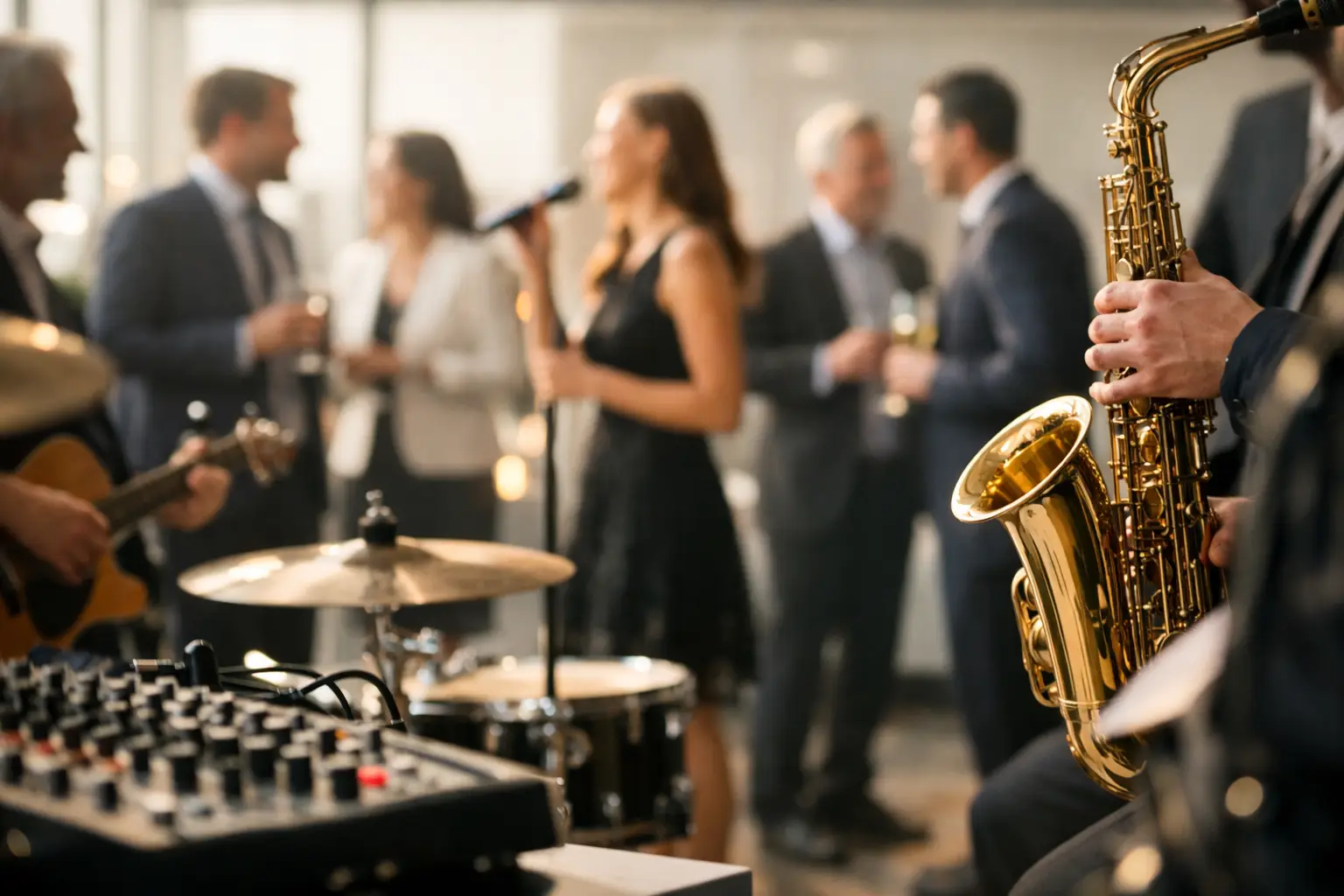
Why music at a corporate event is so much more than entertainment
At private parties, many guests often know each other, generations, and tastes quite well. It's different at a corporate event. Here, departments, hierarchy levels, age groups, and sometimes international guests come together. Therefore, music has to fulfill multiple tasks simultaneously.
It should arrive without being intrusive. It should connect without seeming arbitrary. And it should generate energy at the right moment without disrupting the flow. This is precisely the difference between mere background noise and thoughtful musical accompaniment.
When the music fits, people talk more relaxed, stay longer, laugh more, and are more likely to hit the dance floor. If it doesn't fit, the mood often sours gradually. You don't always notice it immediately, but in the end, everyone in the room feels it.
Guide to Music at Corporate Events: First Understand the Occasion, Then the Songs
Before a song is even selected, you need to clarify the character of the event. A casual company outdoor party requires a different musical dramaturgy than an awards gala or a Christmas party in a hotel. The biggest mistake is to treat every company party the same.
First, ask yourself what the evening should achieve. Is it about employee appreciation, customer loyalty, team building, or a celebration with a real party focus? Almost everything depends on this: volume, style, transitions, moderation, and of course, the question of when background music can turn into real party music.
The number of guests also plays a role. With 40 people, music can seem more personal and direct. With 300 guests, you need more musical breadth and a better feel for how to engage different groups. The age structure also comes into play. A group with many guests between 25 and 35 will react differently than a mixed workforce with three generations in the room.
The most common mistake: wanting too much, too soon
Many organizers immediately think of the party phase. Understandable – everyone wants full dance floors and good photos. But the evening doesn't start there. A company party needs a dramatic arc musically.
For receptions, music works best when it creates atmosphere but doesn't drown out conversation. During dinner or speeches, it needs to be more subdued. Only afterward can it pick up, energize, and ideally, really ignite. Those who try to generate club energy right at the entrance often burn out the guests' attention too quickly.
Good music planning therefore doesn't mean just having good songs. It means playing the right song at the right time. That's exactly what separates experience from luck.
What music really works at company parties?
The honest answer is: It depends. Not every hit is automatically suitable for events, and not every well-known song works in every situation. At corporate events, the organizer's personal musical taste counts less than the impact on the overall group.
Proven choices often include stylistically broad sets with well-known songs, strong rhythms, and clear emotional accessibility. Soul, Funk, Pop classics, 80s, 90s, 2000s, current charts, select dance classics, and international hits often work very well when carefully curated. Especially with mixed audiences, recognition and sing-along potential are more important than niche genres.
Still, music must not become interchangeable. A Christmas party can have warmth. A summer party can sound airier and lighter. An international event might require more stylistic openness. A sales meeting with a subsequent celebration can often handle more energy than a formal client evening.
This shows why pure, standard playlists often fail. They don't react to the space, audience, and dynamics. Music at company parties isn't a static file, but rather a living part of the evening.
Playlist or DJ – what's the better solution?
For small, informal events, a prepared playlist may suffice if the expectations are manageable and no one is expecting a true party. This saves budget initially. However, the solution carries risks: no spontaneous adjustments, no dramatic arc, no reaction to moods, no smooth transitions, and often a lack of knowing the right moment.
When a company event is meant to be more than just pleasant background music, an experienced DJ usually becomes the clearly better choice. Not because technology alone impresses, but because someone in the room can read the mood and guide it musically. This is particularly important at corporate parties, as the audience is diverse and not every group gets into the swing of things at the same pace.
A good DJ knows when conversations should still take priority, when the first guests are loosening up, and when the perfect moment has arrived to truly kick off the evening. Precisely then, this special blend of confidence and energy arises, which carries a celebration.
This is how you plan music for your event
Music should not be discussed only shortly before the event. It belongs in the planning process early on, right alongside technology, catering, and moderation. This is because many problems arise not from the music selection itself, but because the music and the program were not considered together.
At the reception, you need a volume that invites rather than overwhelms. During the meal, music should fill the room but never compete with conversations. For honors, speeches, or presentations, it should be clear whether musical transitions or short jingles are appropriate. And for the later evening, it should be defined from when a real party is desired.
It's also important to discuss no-gos. Some companies want to avoid certain styles, while others expressly desire international titles, a stronger lounge component, or a later escalation on the dance floor. The clearer these points are beforehand, the more precisely the evening can be planned.
The space is also a factor
One point that is often underestimated: the same music sounds different in every room. High ceilings, a lot of glass, open outdoor areas, or cramped event spaces massively change the effect. What sounds good on paper can suddenly seem too harsh, too thin, or too restless on site.
Therefore, good music planning always includes a look at the location, technology, and guest distribution. Where are the bar, buffet, and stage located? Where will people be talking, and where will they be dancing? How close are these areas to each other? If the dance floor and dining area are too close together, it requires a great deal of sensitivity in terms of volume and timing.
Especially at company events, this balance is crucial. Some people want to network, others want to dance. Both must be possible without one group feeling disturbed by the other.
Music requests yes – but with substance
Music requests can make an event personal. However, they shouldn't let the evening become fragmented. If everyone only insists on their own favorite song, the celebration quickly loses its musical common thread.
Therefore, a framework makes sense: Requests are welcome if they fit the occasion and the stage of the evening. An experienced DJ will not play every request blindly but will assess whether it enhances or hinders the mood. This is not a disadvantage but professional protection for your event.
I consistently find that this mix of openness and clear leadership works best. Guests feel seen, yet the evening still keeps moving.
What good company music actually triggers in the end
The goal isn't simply to be as loud or as modern as possible. The goal is for people to feel comfortable, connect with each other, and at the end say, "That was a really good evening." Music carries that part that you can't touch, but immediately feel.
She gives an event heart. She can accompany elegantly, she can motivate, she can create memories. And when used wisely, she can turn a mandatory event into an evening that people are still talking about weeks later.
When planning your company event, don't think about music in terms of songs, but in terms of effect. Then, it's not just background noise, but atmosphere, trust, and at best, that exact moment when the dance floor suddenly comes alive and the evening finds its own pulse.
Book DJ GerreG now & secure your desired date in good time
Are you planning your wedding or another party?Then secure your DJ early! I'll be happy to accompany you from the planning stages to the last encore in the early morning hours. I'm really looking forward to your message! 🎶

🎧 More from DJ GerreG
👉 Website:
https://djgerreg.de
🎧 Spotify:
https://djgerreg.de/spotify
📸 Instagram:
https://instagram.com/djgerreg
Play button YouTube:
https://www.youtube.com/@DJGerreG
🛒 Buy songs (before release):
https://gmusiqrecords.de/shop