
When at a wedding, the aunt loves Schlager, the circle of friends celebrates Afrobeats, one side of the family dances to Balkan beats, and the other goes wild for the 90s, it's not the genre of music that determines the evening – but how cleverly it all comes together. That's exactly why a Wedding with international music mix More than just a long playlist. It needs a feel for people, timing, and someone who can read moods.
I repeatedly experience couples wishing for exactly that: a celebration where everyone feels included. Not just the bride and groom, not just one side of the family, not just one age group. But truly everyone. That sounds like a lot at first, but it's absolutely achievable – if the music isn't played randomly, but is intentionally curated.
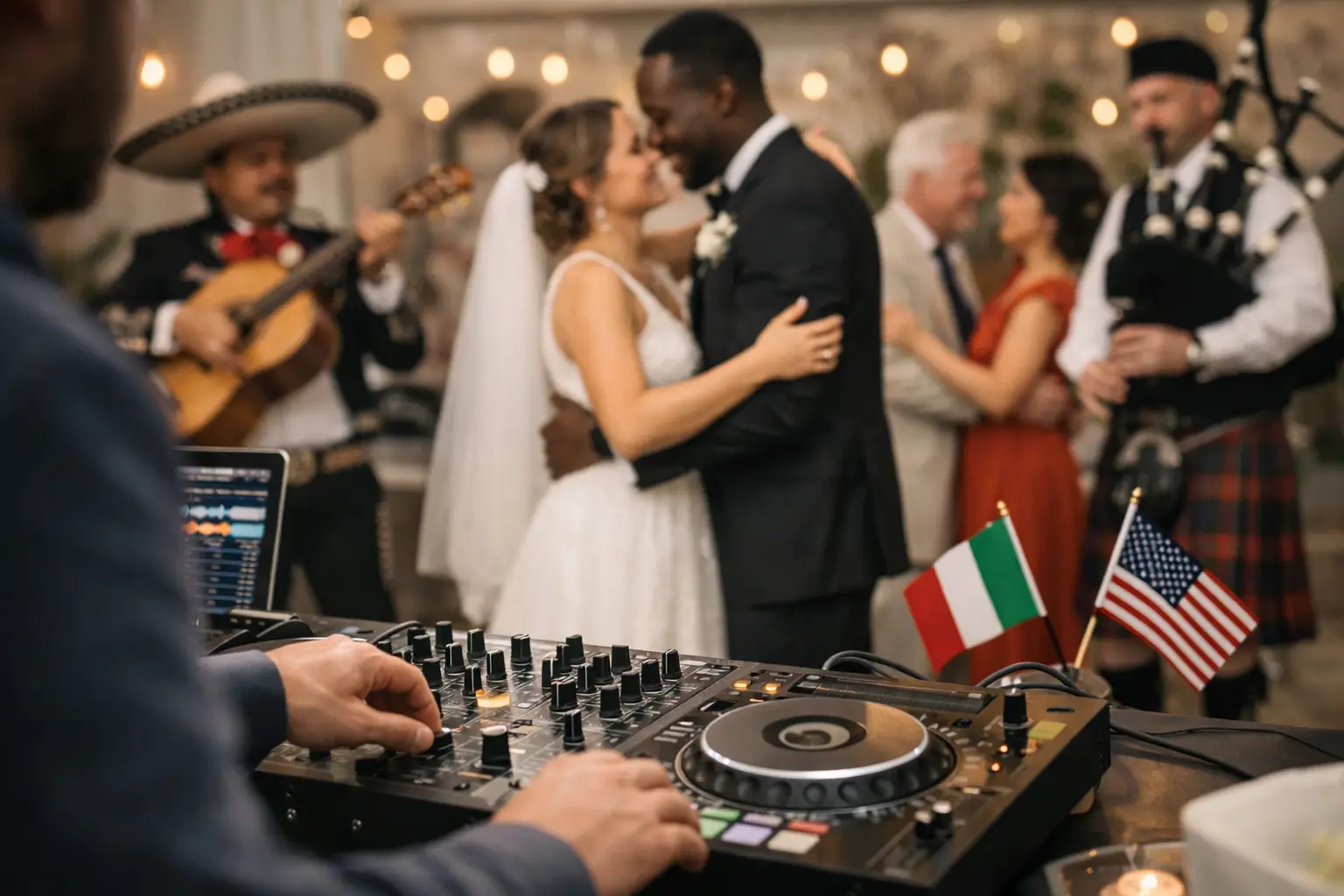
Why a wedding with an international music mix is so special
An international wedding has its own energy. Often, languages, family histories, and musical influences that rarely share a space in everyday life come together. That's precisely where the great opportunity lies. When the right music comes at the right moment, something is created that cannot be planned, but can certainly be prepared for: genuine connection.
The mistake usually doesn't happen with song selection itself, but with the dramaturgy. Many think an international music mix simply means covering as many countries and genres as possible. In practice, this quickly seems restless. A song from one cultural circle, then abruptly a completely different sound, then a stylistic break again – this can tear apart the dance floor rather than fill it.
A good international wedding celebration, by contrast, feels well-rounded. It surprises without becoming chaotic. It honors diverse tastes without the evening falling apart. This requires experience and a feel for when which song truly works.
The most important point: Not diversity alone, but balance.
When you are planning your wedding, it is worth taking an honest look at your guests. Who is really sitting in the hall? Which music evokes memories, which creates enthusiasm, which also appeals to people who don't go out to party every week? This is where good preparation begins.
An international music mix works best when it creates common intersections. These can be world-famous party classics, strong Latin hits, international pop anthems, danceable RnB tracks, cult 80s and 90s hits, or even individual, recognizable songs typical of a country. What's crucial isn't that every nation is represented equally often. What's crucial is that every group feels seen.
Sometimes less is indeed more. If a wedding is, for example, German-Polish, German-Italian, or German-Turkish, the evening doesn't need to musically travel the whole world. It's often enough to strongly and appropriately incorporate the truly relevant styles and develop a common thread from them.
What questions should you ask yourself in advance
Before we get to specific songs, a few simple questions will help. What music do you as a couple connect through? What songs absolutely cannot be missed? Are there any cultural or family traditions that should be accompanied by music? And almost more importantly: what music do you consciously want to avoid?
The spatial distribution also plays a role. Are there many international guests who expect certain music? Are there multiple generations with clearly different preferences? Should the party escalate early or build up slowly? There is no standard answer to these questions. Every wedding is different, and that's exactly why the music mix should also be individually tailored.
This is how the music mix at the wedding will really get people dancing
The best song list is useless if it's played at the wrong time. A good party doesn't just live by the "what," but by the "when." This is especially important for a wedding with an international music mix.
For dinner or a reception, various cultural colors can be subtly incorporated. This creates atmosphere without being overwhelming. Later, when the dance floor opens, it often requires some safe bridges first – familiar hits, catchy grooves, songs with immediate impact. From there, the evening can be intentionally opened up and international highlights can be introduced.
Someone who starts directly with specialty titles often risks only engaging a small group. However, someone who first builds trust on the dance floor can then mix much more boldly. That's precisely when surprising transitions between House, oriental rhythms, Reggaeton, chart hits, Disco, Balkan, Funk, or club classics also work.
A good DJ doesn't just stubbornly stick to Plan A. He looks at the room. Who is dancing right now? Who is still hesitant? What energy is building up? Does the group remain stable, or does the mood change? This observation decides whether an international music mix becomes great or sounds generic.
Common mistakes during a wedding with an international music mix
Many couples mean well and create extremely long wish lists. The problem: a celebration is not a music catalog. If 150 songs from 12 different genres are to be accommodated, pressure quickly builds. The evening needs breathing room, spontaneous reactions, and space for what works in the moment.
Another mistake is thinking in blocks. One hour only this nation, then only that genre – that can work, but it doesn't have to. It's often much more powerful to weave purposefully. A well-known dance classic can transition wonderfully into Latin, an oriental party track into modern charts, a German evergreen into international 2000s hits. This way, more people stay on the dance floor.
The issue of volume is also often underestimated. Especially at family celebrations with multiple cultures and age groups, the music shouldn't be at full blast from the very first moment. Atmosphere isn't created by noise, but by proper development. If you lose guests early on, it's harder to get them back later.
Wishlist Music, No-Gos, and Family Expectations
Clarity is needed here. Of course, important wishes should be accommodated. But not every song that a guest holds dear is automatically suitable for a party. Some titles are emotionally resonant, while others only work for two people at a table. Both are okay – you just need to know where each song belongs.
I always recommend working with clear priorities. A few absolute must-haves, a short list of no-gos, and an open conversation about the guests are often completely sufficient. Based on experience, the situation, and a good feel for things, everything else can develop organically. That's how the celebration stays lively instead of strained.
What music styles often work particularly well
At international weddings, it's often songs with a collective party spirit that build bridges. These include international pop hits, strong 90s and 2000s tracks, danceable disco sounds, well-known Latin tracks, select house classics, and depending on the guest mix, also R&B, Afro, Balkan, or oriental party hits. In addition, there are country-specific songs that create genuine goosebump moments for certain groups.
But here too, the mix is key. An evening full of only current club music can alienate the older generation. Too much nostalgia, on the other hand, can slow down the younger crowd. The art lies in building waves. Sometimes broad and connecting, sometimes more specific and emotional, then again a song that everyone can really sing along to.
When moderation or traditional program elements are added, they should be seamlessly integrated musically. This appears professional, reduces hustle, and maintains attention in the room. This security is enormously valuable, especially at weddings with multiple cultural influences.
Why experience matters more than technique here
Good technology is important, of course. But at a wedding with an international music mix, it's not the lighting, not the sound system, and not the size of the music library that ultimately decides. What matters is whether someone can shape a shared evening out of very different expectations.
This isn't a matter of chance. It's experience. Knowing when to give a special song its space. When to consciously slow things down. When to prominently feature a specific musical genre, and when to cleverly blend it with something familiar. That's precisely where a nice party becomes a night people talk about for a long time.
If you want security for your wedding, don't just look for someone with a lot of songs. Look for someone who can read people. Someone who listens before they play. Someone who understands that your celebration isn't about their music profile, but about your guests, your story, and that one night.
For me, that's precisely the core of good wedding music: not playing as much as possible, but playing the right thing at the right moment. When cultures, generations, and circles of friends celebrate together, exactly what every couple wishes for emerges – a full dance floor with heart.
And that's precisely why it's worth not planning the music on the side, but giving it the importance it deserves.
Book DJ GerreG now & secure your desired date in good time
Are you planning your wedding or another party?Then secure your DJ early! I'll be happy to accompany you from the planning stages to the last encore in the early morning hours. I'm really looking forward to your message! 🎶

🎧 More from DJ GerreG
👉 Website:
https://djgerreg.de
🎧 Spotify:
https://djgerreg.de/spotify
📸 Instagram:
https://instagram.com/djgerreg
Play button YouTube:
https://www.youtube.com/@DJGerreG
🛒 Buy songs (before release):
https://gmusiqrecords.de/shop