
Der Sektempfang läuft, die ersten Gäste lächeln noch höflich, und dann passiert oft genau das, was keiner geplant hat: Die Musik bleibt nett, aber die Stimmung bleibt stehen. Genau an diesem Punkt stellt sich die Frage nach Playlist oder DJ Event nicht mehr theoretisch, sondern ganz praktisch. Denn Musik ist bei einer Feier nicht bloß Hintergrund. Sie entscheidet mit darüber, ob Menschen sitzen bleiben oder tanzen, ob Übergänge holpern oder fließen und ob aus einem schönen Abend ein unvergessliches Erlebnis wird.
I experience it again and again: Many underestimate how much music guides a party. A good playlist can absolutely work for small, uncomplicated occasions. But as soon as emotions, program items, different generations, and a real party atmosphere come together, a DJ often becomes the decisive difference.
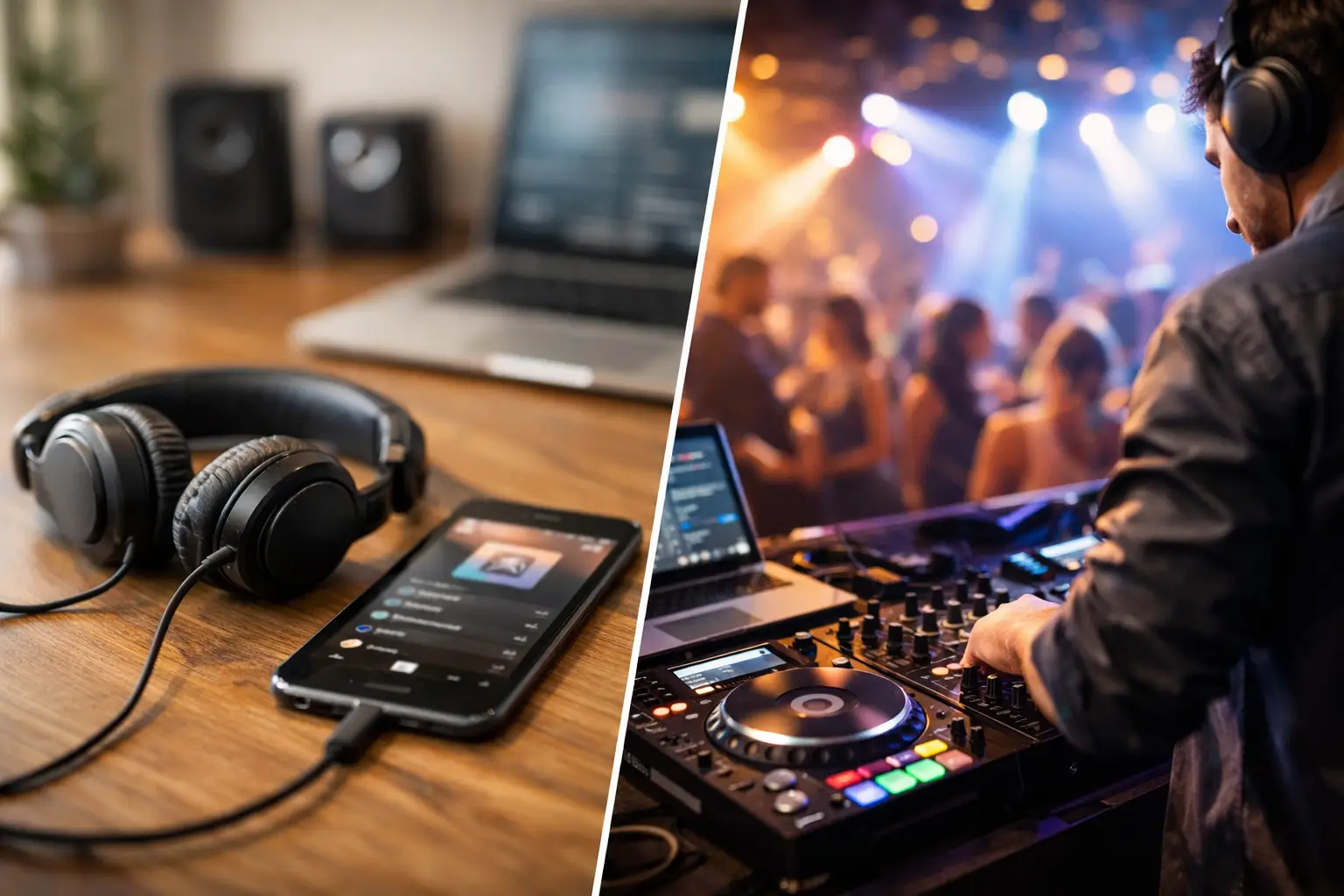
Playlist or DJ event – where lies the real difference?
At first glance, the difference is simple. The playlist costs little, is created quickly, and runs automatically. A DJ is booked, costs more, and is live on-site. In practice, however, the gap is much larger.
A playlist plays tracks. A DJ reads people.
This is especially crucial at weddings, company parties, and milestone birthdays. It's rare for only ten friends with identical musical.
When a playlist is really enough
Not every celebration necessarily needs a DJ. Saying that openly is part of my honest advice.
If you're planning a small, relaxed evening in a private setting, without a big agenda, without speeches, without an opening dance, and without the aim of a packed dance floor until late into the night, a playlist can suffice. This applies, for example, to a casual barbecue, a small reception, or a celebration where music is intentionally meant to be background accompaniment.
Even then, it's still worth honestly checking if no one really needs to take responsibility for volume, transitions, technology, and spontaneous requests. Because often, the effort ends up with the bridesmaids, friends, or colleagues. They actually wanted to celebrate and suddenly find themselves on their phones, adjusting the sound, or frantically searching for the next suitable song.
A playlist therefore primarily saves money when the framework is simple and you accept that music functions rather than excites.
When a DJ event has a clear advantage
Once your celebration needs momentum, a DJ is hard to replace. This is especially true for weddings. Here the mood changes constantly: reception, dinner, emotional moments, speeches, first dance, party. Each phase demands a different feel for music. Too loud too early seems intrusive. Too energetic too late costs energy. It's precisely this timing that makes the difference.
When it comes to company parties, something else is added. Colleagues, management, various departments, and sometimes international guests often celebrate together. No one wants to experience a musical mishap. A good playlist can hardly compensate for this because it doesn't notice when a change of style is needed or when the dance floor is about to empty.
A DJ event is therefore not just music from another source. It is active event control. The music becomes a tool for mood, rhythm, and connection. Good moderation, smooth transitions, and a feel for the room are added on top of that.
The most common mistakes when deciding
Many people first think about song selection. Understandable, but that's only part of the truth. Most playlists don't fail because the songs are bad. They fail because of order, timing, and lack of reaction.
The next misconception is: Our guests only want to hear popular hits anyway. That sounds logical too. But even popular hits don't automatically work. The same song can completely fizzle out at 8:30 p.m. and set the dance floor on fire at 11:15 p.m. Experience shows itself right there.
Then there's the argument that guests can suggest songs themselves. That can be nice too, but it often results in a musical patchwork. A request isn't automatically a good party song for that specific moment. A DJ takes requests seriously, but incorporates them so the evening doesn't fall apart.
Playlist or DJ event for weddings, birthdays, and company parties
For weddings, the answer is usually clear. If atmosphere, security, and a great party are important to you, almost everything points to a DJ. The day is emotionally charged, full of special moments, and often unique in this form. I would never leave music to chance then.
When it comes to birthdays, size and ambition matter more. A 30th birthday with a small circle of friends can be wonderful with a good playlist. A 50th, 60th, or a big anniversary with family, friends, and multiple generations almost always benefits from professional support. Especially when people come together who don't automatically share the same taste in music, it requires a sense of tact.
At company parties, reliability is just as important as a good mood. The schedule needs to be right, the technology must work, and nobody wants to improvise when the microphone, audio clips, or background music aren't right. This isn't just about having a party; it's also about making a professional impression.
The Cost - Cheap isn't always good value
Of course, budget plays a role. A playlist seems almost free at first glance. That's its big advantage. But cheap and inexpensive are not the same thing.
When working with playlists, you often still need technology, someone for setup, someone for operation and emergencies, and in case of doubt, someone to step in spontaneously. Added to this is the risk of losing the mood. And once the mood is lost at a party, it's hard to get it back.
A DJ costs more, no question. But with a DJ, you're not just buying music, you're buying experience, planning expertise, MCing skills, technical understanding, flexibility, and the ability to hold the event together. Especially for important celebrations, this isn't a luxury, but often the more sensible decision.
What many hosts only say after the party
After successful events, I often hear the same sentence: "Glad we didn't do it ourselves." This is rarely because hosts don't know music. It's because they wanted to celebrate instead of taking responsibility.
A good DJ takes the pressure off. You don't have to constantly think about what's playing next. You don't have to worry about song lengths, bridge awkward silences, or placate guests if technical issues arise. You can be in the moment. That's exactly what most people want, especially at weddings and personal family celebrations.
How to Make the Right Decision for Your Event
Don't just ask yourself what music you like. Instead, ask yourself: What do you want to happen at your party? Should it simply be pleasantly accompanied, or should a real mood be created? Should music just play, or should it actively carry the evening?
If a relaxed background solution is enough, not much programming is planned, and no one is disappointed if the dance floor stays small, a playlist can work. However, if you want full dance floors, seamless transitions, security in the process, and the good feeling that someone can really read the room, a DJ event is the better choice.
In the end, it's not about technique, but about impact. The most beautiful celebrations arise where music isn't just present by chance, but purposefully connects people. That's precisely why many hosts consciously opt against the easy solution and for the one that creates memories.
I never see music at events as an afterthought. It's the heartbeat, the mood setter, and often the reason an evening stays in your mind long after it's over. So, if you're wavering between a playlist or a DJ event, don't just think about the song list. Think about the moments you want to experience – and who makes them possible.
Book DJ GerreG now & secure your desired date in good time
Are you planning your wedding or another party?Then secure your DJ early! I'll be happy to accompany you from the planning stages to the last encore in the early morning hours. I'm really looking forward to your message! 🎶

🎧 More from DJ GerreG
👉 Website:
https://djgerreg.de
🎧 Spotify:
https://djgerreg.de/spotify
📸 Instagram:
https://instagram.com/djgerreg
Play button YouTube:
https://www.youtube.com/@DJGerreG
🛒 Buy songs (before release):
https://gmusiqrecords.de/shop
Frequently Asked Questions
A playlist is sufficient for small, relaxed occasions without a big program, speeches, or dancing, such as barbecues or small receptions.
A DJ adjusts music tempo, style, and transitions in real-time, reads the guests' mood, and ensures smooth flow and dynamic party atmosphere.
Because weddings have different mood phases that require different music, and a DJ optimally controls the timing and atmosphere.
Playlists don't react to mood swings, often require technical support, and can lead to inappropriate music choices or bumpy transitions.
Music decides whether guests dance or stay seated, whether transitions flow, and whether a lovely evening becomes an unforgettable experience.
One should consider whether the music should only be background or actively create atmosphere, how much programming is planned, and how important smooth transitions and safety are.