
When couples their Wedding DJ Schedule Planning, it's rarely just about the music. It's about timing, about transitions, about goosebumps at the right moment, and about making sure the evening doesn't drag. This is exactly where a nice playlist separates itself from a party people will still be talking about years later.
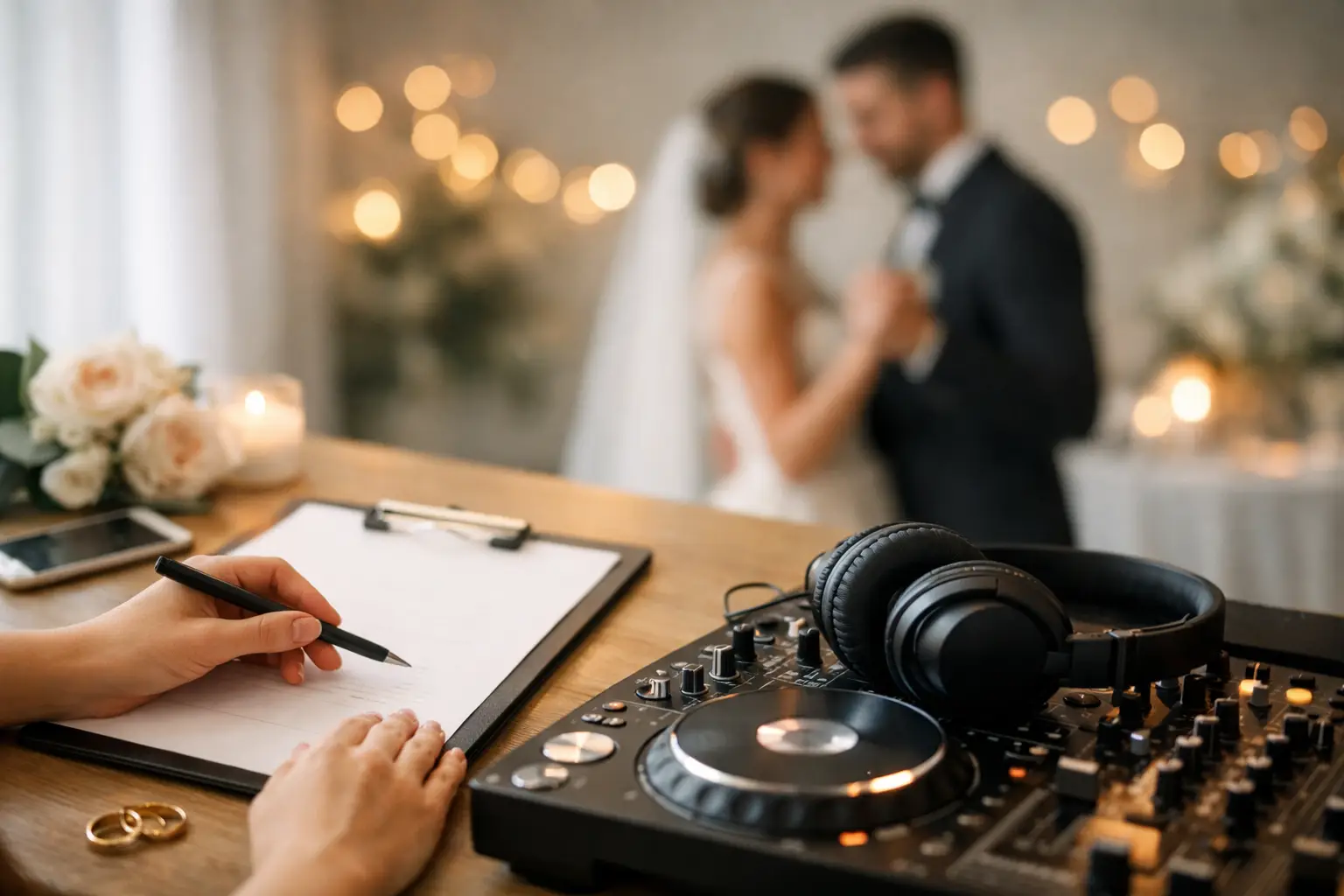
Why the DJ set is more than just a sequence
Many people first think of the wedding evening's first dance and later the party. But in between, everything happens that decides between excitement and stagnation. When does the background music start during dinner, when is the right moment for speeches, when does a wedding game still fit, and when does it dampen the energy – all of this needs to be coordinated precisely beforehand.
A good plan isn't a rigid corset. It's more like a resilient framework that provides enough structure yet leaves room for adjustments when things shift. At weddings, this happens constantly. The meal takes longer, the photographer needs another ten minutes, a speech is added spontaneously, or guests are in the mood to dance much earlier than planned.
Wedding DJ Schedule Planning: First the Dramaturgy, Then the Details
Before writing down the schedule, it's worth taking a look at the overall atmosphere of the evening. Don't just ask yourself what should happen when, but also how you want your guests to feel. Romantic and calm for the reception, relaxed during the meal, attentive during emotional moments, and later lively on the dance floor – this creates an evening with excitement and real dynamism.
That's precisely why the order isn't arbitrary. If too many agenda items come one after another, the celebration loses its lightness. If, on the other hand, everything is left open, there's a lack of direction. The art lies in the balance.
The reception sets the tone
The champagne reception is often underestimated. Yet, it's the moment when your guests arrive, get settled, and experience the atmosphere of the celebration for the first time. Here, you need music that is present but doesn't disturb conversations. Lounge, soul, relaxed pop, or subtle classics usually work better than anything that sounds like a later party.
If the volume or style isn't right here, the party quickly becomes restless. An experienced DJ therefore doesn't just play a request list, but pays attention to the room, guests, and atmosphere.
At dinner, music should carry, not dominate
During the meal, the energy changes. Guests sit, converse, toast, laugh, perhaps listen to a speech. The music needs to support this setting. Too much pressure on the beat quickly feels hectic. Too little atmosphere makes the room feel empty.
It's precisely in this phase that the importance of a well-thought-out flow often becomes apparent. Speeches, surprises, or small interludes shouldn't be placed haphazardly between the main course and dessert. It's better to plan clear intervals. This way, the dinner remains enjoyable, and the guests' attention isn't lost.
What program points you should coordinate with the DJ
A wedding reception thrives on its highlights. For these to be impactful, your DJ needs to know them – and not just five minutes beforehand. This naturally includes classics like the Opening dance, but also seemingly small details like the entrance to dinner, the cutting of the cake, or a planned father-daughter dance.
The most important thing is to coordinate speeches and surprises. If the best man or maid of honor prepares something, the DJ should have at least a rough idea of when it will happen and what technical equipment is needed. If someone needs a microphone, a specific song needs to start precisely, or the dance floor needs to be cleared for a short time, then this should be included in the planning.
Games are also a point where honesty helps. Not every wedding game works at every time. It can fit well right after dinner. But not in the middle of a party that's just getting started. Once the dance floor has picked up steam, you should have very good reasons to stop it again.
The first dance is not an isolated moment
Many couples focus heavily on the song for the opening dance. Understandable – it's an emotional moment. But what happens immediately before and after is just as important. Is the dance announced? Are the guests positioned around the floor? Does it remain romantic after the song, or does the dance floor open up for everyone immediately?
These transitions determine whether the moment feels grand or fizzles out. In many cases, it makes sense to actively involve the guests directly after the first dance. This way, there's no lull, but rather a natural start to the party portion.
Wedding DJ Schedule Planning with Realistic Time Slots
The most common mistake in planning is not a lack of attention to detail, but too much optimism. If a wedding is scheduled minute-by-minute according to plan, it's almost inevitably thrown off track. Realistic time slots with buffers are better.
For example, if the dinner is officially scheduled until 8:30 p.m., that doesn't automatically mean the first dance starts at 8:31 p.m. Guests need transitions. Service needs time. Sometimes the mood is in the middle of a flowing conversation, which shouldn't be abruptly interrupted.
That's why it's better to think in blocks. Reception, dinner, emotional highlights, first dance, party. Within these blocks, your DJ can react flexibly. That's exactly what provides security without making the celebration stiff.
This is what a harmonious evening often looks like
A typical flow begins with light background music for the reception, transitions into stylish dinner accompaniment, then makes space for one to three selected highlights, and finally builds up specifically towards the first dance. Afterward, the dance floor opens, usually first with songs that appeal to multiple generations, before more party tempo is possible later on.
This isn't a strict must. Some couples prefer to cut the cake later, while others want to dance right after eating. Both can work. The key is that the order suits your guests' structure and your style.
What really fills up the dance floor
A full dance floor isn't just created by good songs. It's created when the path to it is right. When guests feel comfortable, the volume is appropriate, there are no unnecessary breaks, and the DJ can read the room.
Often at weddings different generations, musical tastes, and celebration styles collide. The uncle loves disco fox, The friends celebrate the 90s and house music, the parents like classics, and the wedding couple wants personal favorite songs. That's no problem – if someone is at the DJ booth who can turn it into a successful party.
Experience helps more here than any rigid playlist. Because what seems logical on paper doesn't necessarily work in the room. Sometimes a song works immediately, sometimes it needs two clever bridges. Good DJs therefore not only plan the sequence of events, but also the energy curve of the evening.
Typical errors in schedule planning
Many problems arise not from a lack of effort, but from incorrect assumptions. One of the biggest mistakes is trying to fit too many program items in. When speeches, games, a photo booth, cake, a slideshow, and multiple surprises are crammed in, there's often too little left of the actual celebration.
Another classic is poor communication. If the venue, bridesmaids, catering, and DJ all have different times in mind, the evening will be unnecessarily bumpy. It's often enough to clarify all the important points cleanly once.
And then there's the desire to control everything down to the last detail. Of course, you want your wedding to be reliably planned. But the best celebrations have life in addition to structure. If the mood is right, you shouldn't interrupt it just on principle.
How to plan sensibly with your DJ
The best conversation with the DJ doesn't start with asking about the first party song, but with you. How do you want to celebrate? Elegant and relaxed, casual and dance-heavy, family-oriented and emotional, or with a lot of pressure on the dance floor from the very first hour? Almost everything else follows from that.
After that, it's about the key points of the day, desired moments, no-gos, and the guests. Who is coming, what is the age of the audience, are there international guests, should it be moderated or rather discreetly accompanied in the background? The clearer this picture is, the more precisely the schedule can be coordinated.
From my experience, I can say: the best evenings always happen when planning and trust come together. A couple doesn't need to know every single song. They need to have the secure feeling that the atmosphere is being guided without seeming artificial. That's exactly what an experienced wedding DJ is for.
If you want exactly this kind of security for your celebration, a personal consultation can make the difference. On https://djgerreg.de you will find a Direct way to the request.
The perfect plan is one that leaves room for genuine moments.
Your wedding doesn't need a military minute-by-minute schedule. It needs a flow that supports you, includes your guests, and allows for heart, calm, and energy in the right places. When music, timing, and emotion come together, it doesn't just become a party – it becomes an evening that lasts.
Book DJ GerreG now & secure your desired date in good time
Are you planning your wedding or another party?Then secure your DJ early! I'll be happy to accompany you from the planning stages to the last encore in the early morning hours. I'm really looking forward to your message! 🎶

🎧 More from DJ GerreG
👉 Website:
https://djgerreg.de
🎧 Spotify:
https://djgerreg.de/spotify
📸 Instagram:
https://instagram.com/djgerreg
Play button YouTube:
https://www.youtube.com/@DJGerreG
🛒 Buy songs (before release):
https://gmusiqrecords.de/shop


