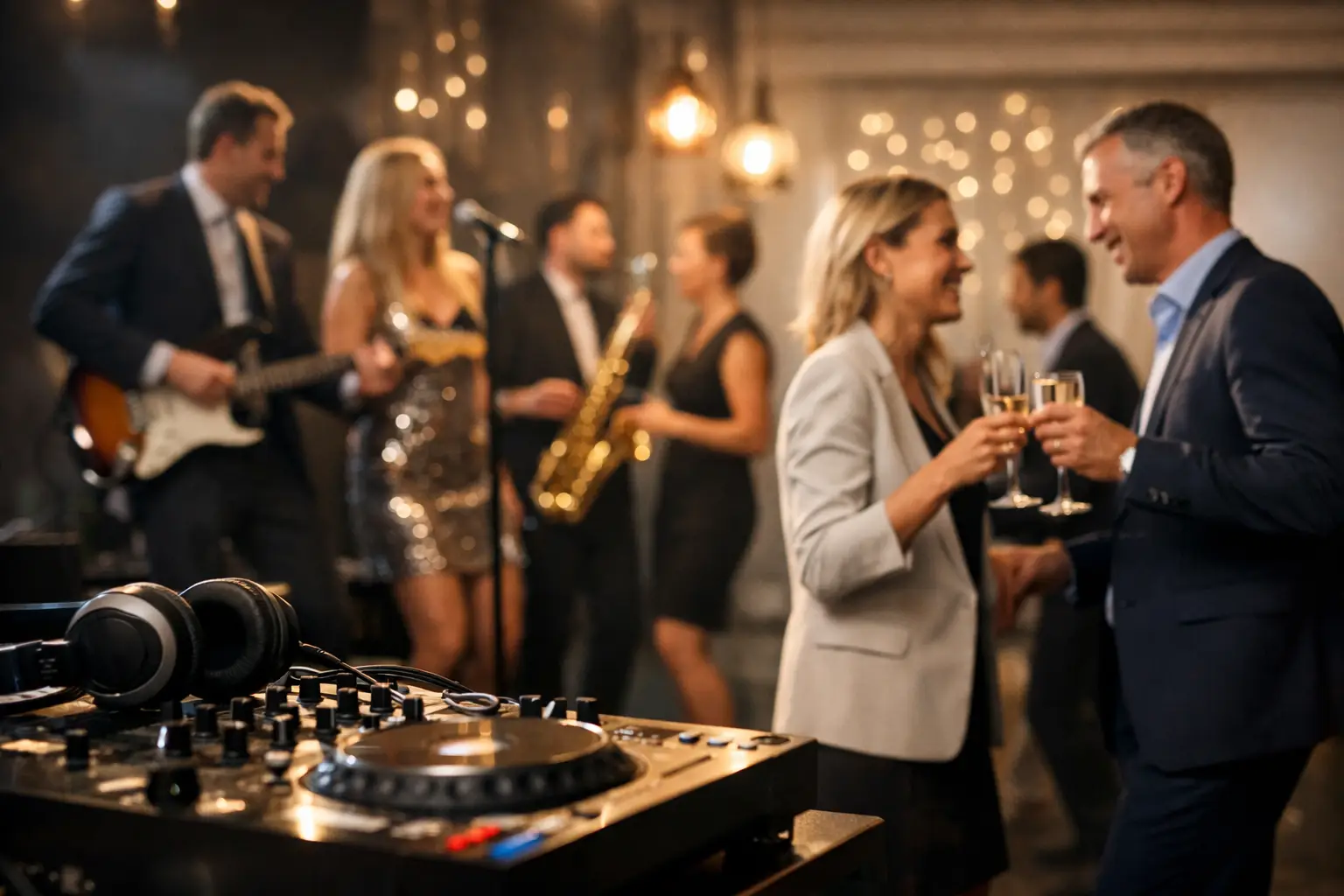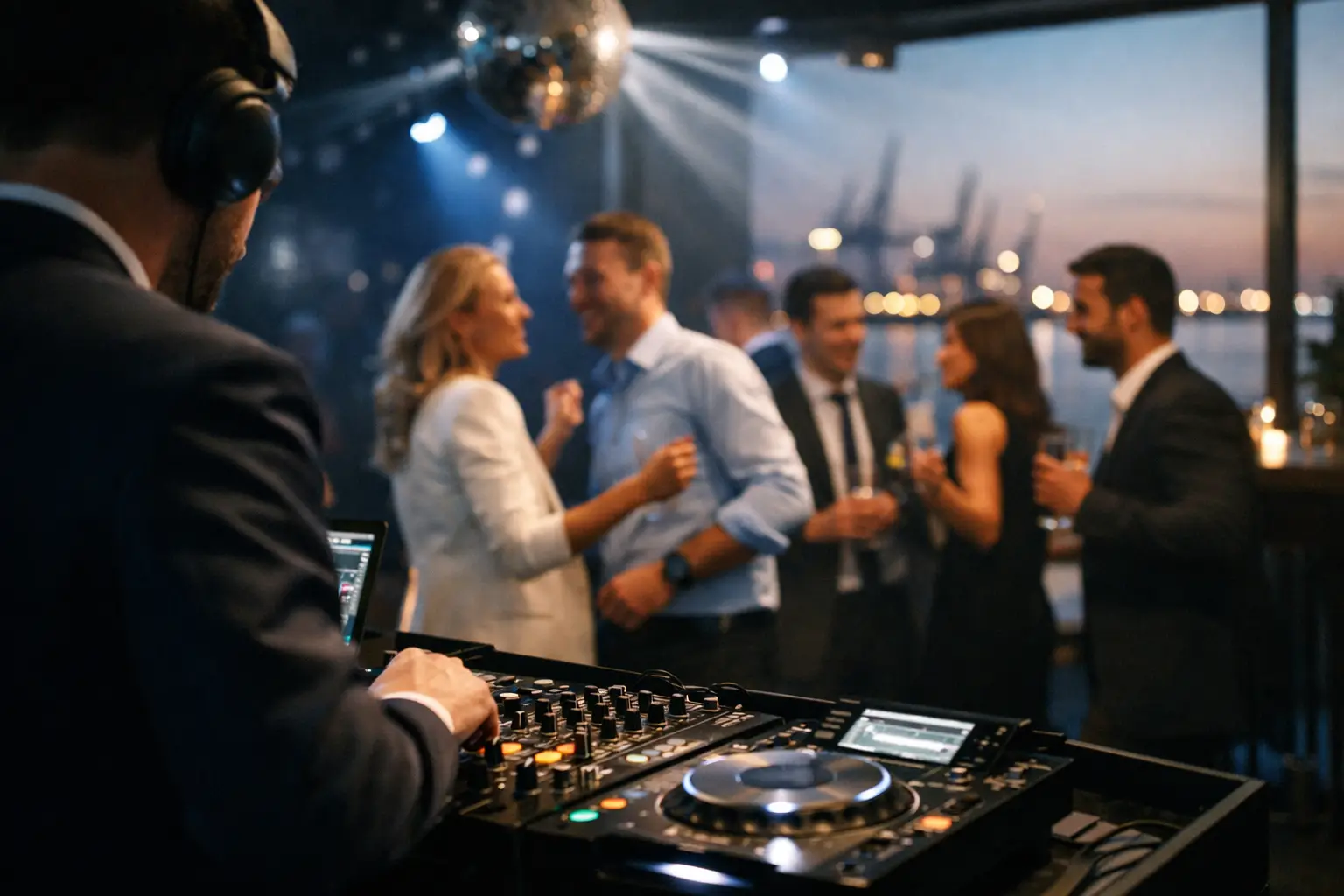
If a company party gets off to a slow start, it's rarely the guests' fault. Usually, the problem lies with the underlying elements: wrong timing, unclear pacing, music that lacks sensitivity to the audience, or a schedule that makes people look at their watches rather than the dance floor. For those who, at a Company party that aims to specifically boost morale, doesn't need a random principle, but rather a clear concept with heart, experience, and the right feeling for people.

Boosting company party atmosphere deliberately doesn't mean just getting louder
Many people first think of high volume, fast beats, or the most spectacular show possible when it comes to a good mood. In practice, this rarely works. A good mood doesn't happen at the press of a button. It grows when guests feel comfortable, are engaged, and realize: something has been thought of for them here.
Just at Company parties Often, it's not just a circle of friends in the room, but a mix of management, apprentices, long-term employees, new colleagues, and sometimes partners or clients. This mix is an opportunity, but it makes planning more challenging. What works easily at a summer party can completely fail at a Christmas party. Therefore, the most important question is not: What's trending right now? But rather: What suits your guests and the goal of the evening?
The biggest mood killer is a weak start
The first 60 to 90 minutes decide more than many event organizers believe. If the reception feels too cool, the music is too quiet or too trivial, or program points drag on, the room quickly falls into a waiting posture. And it's difficult to get people out of that posture later.
A good start is not intrusive, but noticeable. The music should create atmosphere without drowning out conversations. The lighting should seem inviting, not sterile. And the flow must be designed so that guests don't stand around aimlessly in the room for minutes. Especially after arriving, people need small emotional cues that the evening will be something special.
This is where experience really shows its importance. Because a company party requires a different feel than A wedding. The guests know each other to varying degrees, many are more reserved at first, and no one wants to appear too boisterous too early. That's precisely why the atmosphere needs to be built up carefully.
The music must read the audience, not just play playlists
If you want to specifically boost the company party vibe, there's no getting around music. But Music is not always the same.. A good playlist can be nice. An experienced DJ can read situations, control the energy, and play the crucial track at the right moment.
The difference is enormous. At company parties, you often need several musical phases in one evening. First, relaxed accompaniment during the reception, then pleasant tunes during dinner, later a deliberate build-up of excitement, and finally a set that brings different age groups together. Anyone who goes full throttle too early burns out the evening. Anyone who brakes too long loses momentum.
It becomes particularly tricky when organizers plan their celebration too much based on their own taste. Of course, your favorite music can be included. But the best atmosphere is created where as many guests as possible can find themselves. This doesn't mean random. It means crowd-pleasing, intelligently curated, and with the courage to react flexibly to the space.
The process determines whether the mood is created or lost.
Many company parties are actually well-intentioned and yet clumsily structured. Too many speeches, tactless program items, or long setup times drain energy from the room. Guests forgive a lot, but not unnecessary lengths.
An engaging evening needs rhythm. After arriving comes a phase of orientation, followed by shared attention, then relaxation, then activation. This arc of tension is not a luxury, but the basis for a celebration that becomes not just orderly, but lively.
The following applies: Less is often more. A short, well-placed address is more impactful than three successive verbal contributions. An honor ceremony with clear dramaturgy is more memorable than a program item that gets lost. And if the transition to the party is missing after the meal, half of the guests remain mentally in restaurant mode.
This is precisely where a professional DJ with event experience can be of enormous help. Not only musically, but also with timing, smooth transitions, and, if desired, with subtle moderation that holds the evening together rather than interrupting it.
Morale arises from participation, not coercion.
Nobody likes embarrassing animation. This is a sensitive topic, especially at company parties. Guests want to feel comfortable, not put on display. Nevertheless, a good evening needs moments that take people out of their observer role.
This can look very different. Sometimes a cleverly placed musical break that appeals to several generations at once is enough. Sometimes a shared start on the dance floor helps, without pressure or silliness. And sometimes it just takes the right song at the right moment to turn hesitation into movement.
The important thing is that participation feels natural. If the celebration is too heavily staged, it creates distance. If it's left completely to its own devices, the impetus is often missing. The art lies in between. Precisely where people aren't pushed, but willingly join in.
Space, light, and volume are not secondary matters.
I experience it again and again: the music is right, the guests are open, and yet the spark doesn't catch on immediately. Then it's often down to the environment. Lighting that's too bright keeps people at a distance. A poorly positioned dance floor looks uninviting. And a volume that's either annoying or lacks energy can ruin a lot.
It's especially at company parties that it pays to look at the details. Where is the dance floor located in relation to the bar, buffet, and seating areas? Is there a visible center of activity? Is the party zone recognizable as such, or does it get lost in the room? Questions like these sound technical, but they often determine whether guests remain seated or whether they move towards the celebration.
Here too, there's no rigid recipe. A casual outdoor summer party requires different solutions than an elegant Christmas party in a ballroom. But the principle remains: atmosphere must be actively created. It doesn't just happen automatically because there's food, drinks, and music.
The target audience for the celebration determines the right style.
Not every company party should get out of hand. That's an important point. Some companies deliberately want a stylish, communicative evening with a late loose dance floor. Others wish for a real party format that connects colleagues and remains a lasting memory. Both can be right.
The mistake is assuming a goal that was never clearly defined. Should the evening express appreciation? Should it bring teams together? Should it celebrate an annual goal? Or should it primarily be fun and energizing? The clearer this question is answered, the better music, schedule, and atmosphere can be tailored to it.
One Company party A traditional company often requires a different approach than a young startup. Internationally staffed teams react differently than long-established workforces. And with mixed age groups, a music focus that is too narrow rarely works. Good atmosphere therefore doesn't mean being as modern as possible. Good atmosphere means taking the character of the audience seriously.
Why experience at company parties matters so much
Company parties often seem straightforward from the outside. In reality, they are one of the most demanding types of events. Guests arrive with different expectations, hierarchies are present, and the mood often needs to develop carefully. Those who rely only on technology or standard playlists here miss out on potential.
Experience is not shown in grand speeches, but in the right intuition. When does a space need restraint? When can energy rise? When is a classic stronger than a trend? And when must the plan be spontaneously adjusted because the audience reacts differently than expected?
These very subtleties are what ultimately decide whether your celebration was nice or truly memorable. When I accompany events, it's never just about playing music. It's about bringing people together, feeling the transitions, and turning a program item into an evening with a real memory.
This is how to specifically boost the company party atmosphere without it feeling artificial
A company party is strongest when planning and spontaneity go hand in hand. You need a clear framework, but within that framework, there must be room for genuine moments. For reactions, for dynamics, for the music that suddenly opens everything up.
That's why it's worth thinking about the mood early on, rather than just before the event. Who's coming? What should the evening trigger? How should the celebration feel when the first guests go home? These questions are more practical than they sound because they set the direction for everything else.
When music, flow, lighting, and timing come together, exactly what every event organizer desires comes to life: a packed dance floor without feeling forced, relaxed conversations, palpable joy, and the good feeling that this evening was truly unforgettable. And that's precisely what matters in the end – not loudness, but genuine atmosphere that carries people along and resonates long after.
Book DJ GerreG now & secure your desired date in good time
Are you planning your wedding or another party?Then secure your DJ early! I'll be happy to accompany you from the planning stages to the last encore in the early morning hours. I'm really looking forward to your message! 🎶

🎧 More from DJ GerreG
👉 Website:
https://djgerreg.de
🎧 Spotify:
https://djgerreg.de/spotify
📸 Instagram:
https://instagram.com/djgerreg
Play button YouTube:
https://www.youtube.com/@DJGerreG
🛒 Buy songs (before release):
https://gmusiqrecords.de/shop