
Those who think of just any jingle when it comes to corporate music are missing out on potential. Custom music production for businesses can be much more – it can make a brand audible, emotionally charge an event, and ensure that a performance not only appears professional but also stays in people's minds.
This is precisely where the difference lies between off-the-shelf music and a production that truly fits your company. When music is precisely tailored to the occasion, target audience, and brand impact, it doesn't just become a nice addition; it becomes a building block for atmosphere, recognition, and identity.
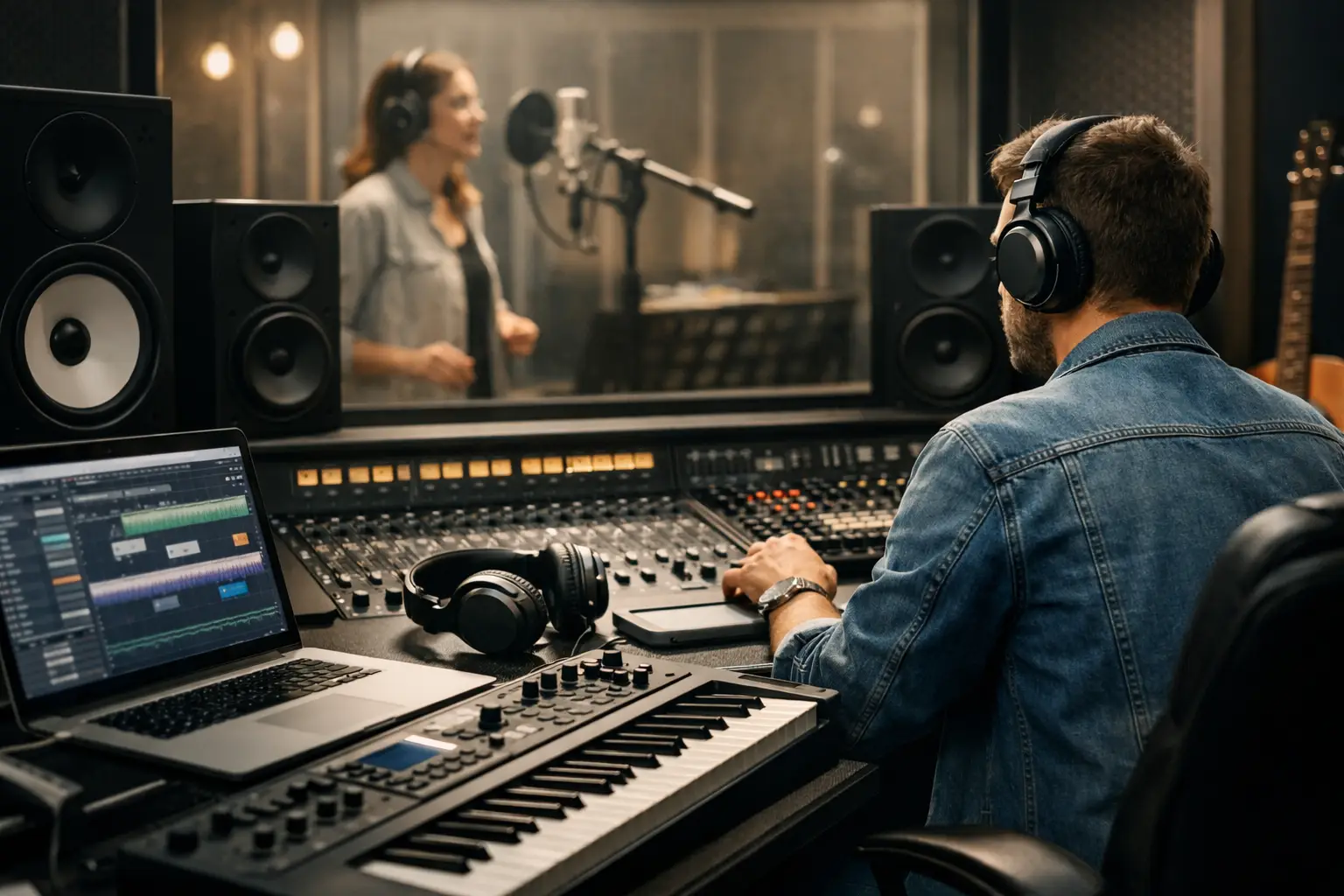
What commissioned music production for businesses really achieves
Many companies only consider this topic when a specific occasion arises. Perhaps you're planning a trade fair, a company anniversary, a product launch, an image film, or A Christmas party. Then the question quickly arises: What music truly carries this moment?
A good Contract manufacturing It answers exactly that. It doesn't just deliver a song, but a musical solution. Sometimes it's about a concise brand sound, sometimes about an emotional opener for an event, and sometimes about background music that sounds professional without being generic.
The great advantage lies in the perfect fit. Tempo, instrumentation, dramaturgy, and mood are not chosen randomly but are tailored to your intended use. This is particularly valuable when you want music not just to fill space but to create an impact.
When custom production is worthwhile for companies
Not every company needs a complete sound identity right away. But there are situations where custom music production pays off noticeably.
This is especially evident at live events. A dedicated intro track for the awards ceremony, a custom opening for the CEO's presentation, or music built for emotional impact during admission can turn an ordinary program item into a true kickoff. Guests often don't notice the details of *why* something feels more premium, but they feel it.
Music also plays a crucial role in videos. A recruiting clip, a corporate film, or Social media content wins clearly when the music doesn't sound interchangeable. Especially when you want to present yourself as a brand with a unique identity, individual music is often the cleaner path than standard libraries.
Adding to that is a point that is often underestimated: control. With commissioned production, you can influence the length, structure, dynamics, and character. This saves compromises later because the music doesn't have to be made to fit, but rather is created to fit from the start.
Commissioning music production for businesses is not child's play
Some decision-makers are rightly asking themselves if this is really necessary. The honest answer is: it depends.
If music in a project only plays a minor role, a simple solution is sufficient in some cases. But as soon as music becomes part of the external impact, the calculation changes. Then it's not just about something playing, but about how something is perceived.
The overall impression is crucial, especially at events with clients, employees, or business partners. Lighting, moderation, flow, and music all work together. When the music supports, connects, or energizes at the right moments, it elevates the entire experience. And that's precisely what lingers in people's memories.
From my experience in the event industry, I know how strongly people react to musical nuances. Not theoretically, but directly in the room. A heartfelt opening, a well-timed arc of tension, a moment that resonates – these often decide whether an event was just okay or truly impactful.
Here's what a professional music production process looks like:
The most important step doesn't happen in the studio, but before it. First, it must be clear what the music is intended to achieve. Is it about attention, emotion, elegance, energy, or recognition? Should the production sound modern and powerful, or rather subtle and high-quality? Knowing the audience leads to better decisions here.
Following this is the creative translation. Sound is generated from brand values and event objectives. This sounds easier than it is. Because terms like high-quality, dynamic, or friendly can be implemented musically in many different ways. That's precisely why personal coordination is so important. Only when expectations are clearly discussed will something be created in the end that is not only technically well-produced but also truly fitting.
In the next step, it will be produced, arranged, and refined. Depending on the project, several versions may make sense – for example, a short version for social media, a longer version for event inserts, or a reduced version for background use. Good commissioned productions consider these applications directly.
Finally, it's all about the finishing touches. Volume, transitions, timing and format must be right for the respective application. A track that works in a movie often needs different accents than music that is to be played over an event system in a hall.
What to look for when choosing a producer
Not everyone who can produce music automatically understands corporate events. That's an important distinction. For companies, it's not just creativity that counts, but also reliability, timing, and a feel for real-world impact.
Therefore, pay attention to whether someone is not only at home in the studio but also understands how people react at events, in presentations, or in brand staging. Someone who knows from practical experience when music should carry, when it should recede, and when it should create a climax usually delivers better results than someone who only thinks from a pure production perspective.
Likewise, communication is important. You don't need a producer to impress you with jargon. You need someone who listens, asks clarifying questions, and translates your ideas into results that work for your business. Good collaboration feels clear, not complicated.
If it also experience from Live entertainment and audience feeling emerges, it becomes particularly valuable. Because then music is not created in a vacuum, but with a real understanding of how atmosphere is built.
What distinguishes good corporate music from any music
The biggest difference is intent. Any music accompanies. Good company music leads.
It sends signals without being pushy. It can feel modern without being fleeting. It can be emotional without sounding cheesy. And it can build energy without being arbitrarily loud. This balance is crucial, especially in a business environment.
On top of that, there's recognizability. Not every company needs an audio logo. But many benefit from a consistent musical identity. Those who convey a similar character in event intros, brand videos, and key brand moments appear more cohesive and professional.
This is not purely a creative question, but a strategic one. Because people don't just remember content. They remember how something sounded and how it felt.
For which formats is commissioned production particularly suitable
Individual music is particularly useful for corporate events, award evenings, openings, trade fairs, product presentations, and internal events with an emotional component. Developing your own musical signature can also be worthwhile for video formats, podcasts, or recurring corporate series.
Sometimes, a well-produced intro or outro is enough to significantly elevate the quality of a format. In other cases, a complete track makes more sense, for example, when an event needs its own narrative structure. So, it doesn't always have to be a big production. The key is how much the music should support your performance.
Those who don't want to leave events to chance don't relegate music to an afterthought. It should be integrated early in the planning. That's precisely when solutions emerge that don't just fit somehow, but have a real impact.
Why personalized voting makes a difference
Trust is crucial, especially when it comes to creative services. Music is a matter of taste – but in a corporate context, it's more than just that. It needs to suit your brand, your occasion, and your guests. That's why commissioned productions work best when they aren't handled anonymously.
When I plan or produce music for special occasions, it's never just about tracks or technique. It's about people, mood, and the moment that will be remembered later. It's precisely this attitude that also makes a difference for companies. Because an event or a brand presence shouldn't just seem correct, but lively, cohesive, and convincing.
If you're looking for music for your company that doesn't sound interchangeable but has character, an individual solution is worthwhile. At https://djgerreg.de, you'll find more about my work between event practice, musical intuition, and personal coordination – always with the goal of turning an occasion into an experience.
In the end, it doesn't matter if music can be technically described perfectly. What matters is whether it evokes something – in your guests, in your customers, and in everyone who experiences your performance.
Book DJ GerreG now & secure your desired date in good time
Are you planning your wedding or another party?Then secure your DJ early! I'll be happy to accompany you from the planning stages to the last encore in the early morning hours. I'm really looking forward to your message! 🎶

🎧 More from DJ GerreG
👉 Website:
https://djgerreg.de
🎧 Spotify:
https://djgerreg.de/spotify
📸 Instagram:
https://instagram.com/djgerreg
Play button YouTube:
https://www.youtube.com/@DJGerreG
🛒 Buy songs (before release):
https://gmusiqrecords.de/shop


