When the first note begins, it often determines how your ceremony feels. That's exactly why the Music for a free wedding ceremony not just a background. It carries your entry, gives space to words, catches tears, and ensures that this moment becomes not just beautiful, but truly unforgettable.
Many couples underestimate how much music shapes a civil ceremony. They first think about the first dance, the party, or the big celebration in the evening. However, the ceremony is the emotional core of the day. What happens musically here often resonates more deeply than much of what happens later on the dance floor.
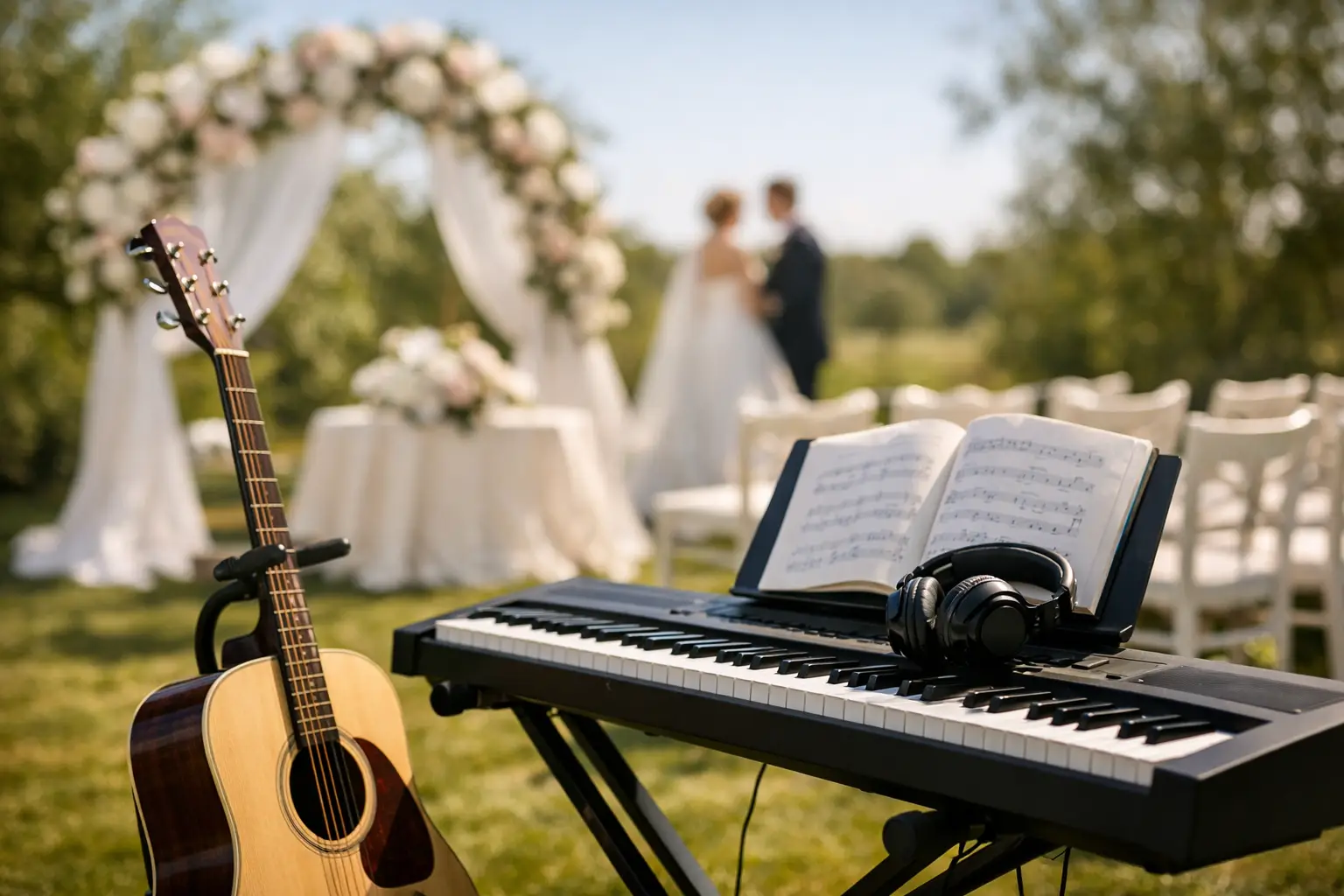
Music for a free wedding ceremony is more than a playlist
A secular wedding thrives on personality. That's precisely why standard music rarely works truly well. Of course, there are songs that are often chosen and are popular for good reason. But just because a song is played at many weddings doesn't mean it's right for you.
The real music It has to achieve two things simultaneously. It needs to be emotional, and it needs to fit into the flow. A song can be beautiful and yet, at the wrong moment, seem too long, too quiet, or lyrically unfitting. Conversely, a rather simple track can give you goosebumps at precisely the right moment because it tells your story.
I repeatedly see in practice that it's not the most famous song that wins, but the most honest one. The song that makes you look at each other immediately. The chorus that you associate with a shared moment. Or even an instrumental piece that doesn't explain much, but simply builds the right mood.
Which moments should be planned musically
At a free wedding ceremony, there are several fixed points where music is particularly important. The processional is the most emotional start. It can be grand here, but not overdone. It's not about outdoing a movie soundtrack. It's about the path leading to you being fitting.
After moving in, quiet phases often follow, during which music can provide subtle support. Some couples wish for interludes after readings or rituals. This can work very well if it's not overdone. Too much music can sometimes take away from the naturalness of the ceremony. Too little, on the other hand, can make it seem a bit sober.
A particularly powerful moment is the underscoring during a ritual, such as a ring blessing, a sand ritual, or the lighting of a candle. Here, the music should not distract from the event, but rather support it. Instrumental tracks or songs with a gentle build-up often work better than pieces with very prominent lyrics.
The excerpt may then gladly release, lighten, and open up. After all the tension and emotions, this is the point where joy is allowed to be expressed loudly. Many couples consciously choose a song with more energy here. This is often a good decision because the mood immediately moves forward – towards congratulations, Champagne reception and celebration.
Here's how to find the right music for a free ceremony:
The most important question isn't: Which song is currently popular? The better question is: What do you immediately feel something for? If you just think a song is suitable for weddings, that's usually not enough. But if you're both smiling within the first few seconds, remembering something, or pausing for a moment, then you're closer.
It's helpful if you don't start with an endless list, but with your moments. Which song reminds you of the beginning? Is there a song from a vacation, a concert, or a road trip that has stayed with you to this day? What music do you *really* listen to together – not theoretically, but in real life?
Then comes the second step: the reality check. Does the song's length, mood, and lyrics truly fit the situation? A beautiful love song might be surprisingly unsuitable in terms of lyrics if it's actually about separation, longing, or unrequited love. This happens more often than many people think.
The length also plays a role. For the entrance, a song with a long intro is often ideal. For a short ritual, the same length might be too much. Sometimes it's enough to trim a song cleanly or fade it in and out at the right spot. It's precisely these subtleties that ultimately make the difference between nice and seamless.
Live music or DJ - what fits better?
This question cannot be answered definitively. It depends on what you envision for your secular ceremony and how the rest of the day is structured. Live singing can be extremely emotional. A good voice with the right acoustics often creates a very intimate, special moment.
A DJ offers other advantages. The song selection is almost limitless, transitions can be precisely planned, and versions can be accurately matched to timing and flow. If the ceremony, reception, and celebration are musically managed by one person, there is often more peace behind the scenes. There is less coordination effort, fewer interfaces, and more security.
Just at outdoor weddings Reliability is crucial. Wind, changing volumes, greater distances, or spontaneous adjustments to the proceedings are not minor issues. It quickly becomes apparent here how important experience and clean technique are. The most beautiful song selection is of little use if the officiant's voice doesn't come through clearly or the music starts too late.
Typical song selection mistakes
A common mistake is to over-pack the ceremony with music. Too many songs don't make the ceremony more emotional, but rather more restless. Every piece of music needs a reason. If a song is only played because you wanted to fit music in somewhere, it shows.
The next mistake is choosing based on taste alone, rather than effect. Of course, you want to like the music. But you also have to consider how it will sound in the space. A very intimate, quiet song can be perfect in a small garden and get lost in a large open area. An epic track can be moving, or quickly feel too heavy – depending on the setting.
Even spontaneous technical solutions are risky. Connecting a phone to a speaker and hoping everything works sounds simple at first. On the wedding day, this is often the source of stress. Volume, starting points, wireless microphones, power supply, and weather resistance need to be right. Those who improvise here rarely save money in the right place.
Which songs often work well – and why
There is no universally applicable top list that fits every couple. Nevertheless, patterns emerge in many free wedding ceremonies. For the entrance, titles work well that have a clear narrative arc and open up emotionally without immediately overwhelming. For rituals, calm instrumentals or gentle acoustic versions are often stronger than well-known originals with dominant lyrics.
During the exit, songs can become brighter, happier, and a bit grander. Titles that tell of love not just romantically, but also lightly and vibrantly, often fit perfectly here. When guests smile, clap, or are visibly moved after saying "I do," the music has done its job.
Here is an example from practiceEntrance music: „Hells Bells“ by ACDC and exit music: „Warum hast du nicht nein gesagt“ (Why didn't you say no). You see: You can also make the music for a free wedding humorous.
What I always advise couples: Don't just listen to your selections once in the evening on the sofa. Listen to them in the morning, in the car, one after another, and in the order they'll be played. That way, you'll quickly notice if the pacing works. The music for a celebrant-led wedding doesn't just need to be good individually – it needs to work together.
Why timing is almost more important than the song itself
A perfect title can lose its impact if it starts two seconds too late. This sounds petty, but it isn't. Especially at a free wedding ceremony, a lot depends on transitions. The processional doesn't start randomly. It starts precisely when the moment opens. The recessional doesn't start when everyone is already walking, but at the very instant the joy crests and wants to move forward.
That's why music should never just be chosen, but always considered as part of the overall flow. Who gives the cue? How long is the path? Is there an intro? Should the song play completely or only up to a certain point? These questions contribute to whether your wedding ceremony will feel light, emotional, and professional.
When I manage processes like these, it's precisely about that security. Not just about good music, but about the feeling that you don't have to worry about that part. Because in the end, you shouldn't be thinking about start buttons, speakers, or setups. You should feel the moment.
Your wedding doesn't need a perfect playlist, but the right one.
Not everything has to be original. It doesn't have to be exclusive. And it doesn't have to please every guest. Your free ceremony isn't a music competition, but a personal moment with real heart. If the music reflects you, carries the flow, and leaves room for emotion, a lot has already been achieved.
Therefore, do not rely on chance or any standard lists. Take your time for the selection, think through the process, and choose songs that evoke something in you. That's when music becomes not just accompaniment, but a lasting memory.
Book DJ GerreG now & secure your desired date in good time
Are you planning your wedding or another party?Then secure your DJ early! I'll be happy to accompany you from the planning stages to the last encore in the early morning hours. I'm really looking forward to your message! 🎶

🎧 More from DJ GerreG
👉 Website:
https://djgerreg.de
🎧 Spotify:
https://djgerreg.de/spotify
📸 Instagram:
https://instagram.com/djgerreg
Play button YouTube:
https://www.youtube.com/@DJGerreG
🛒 Buy songs (before release):
https://gmusiqrecords.de/shop