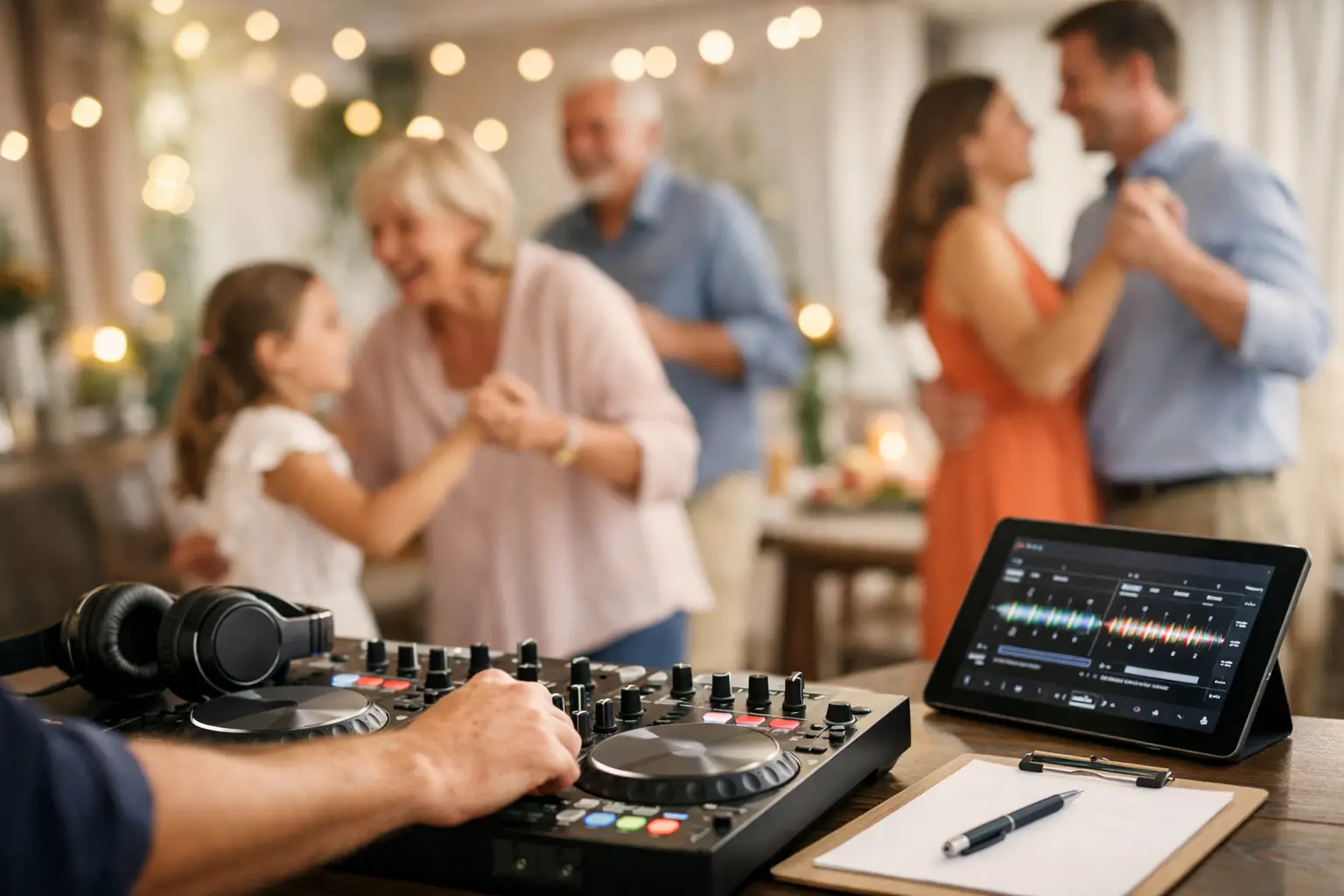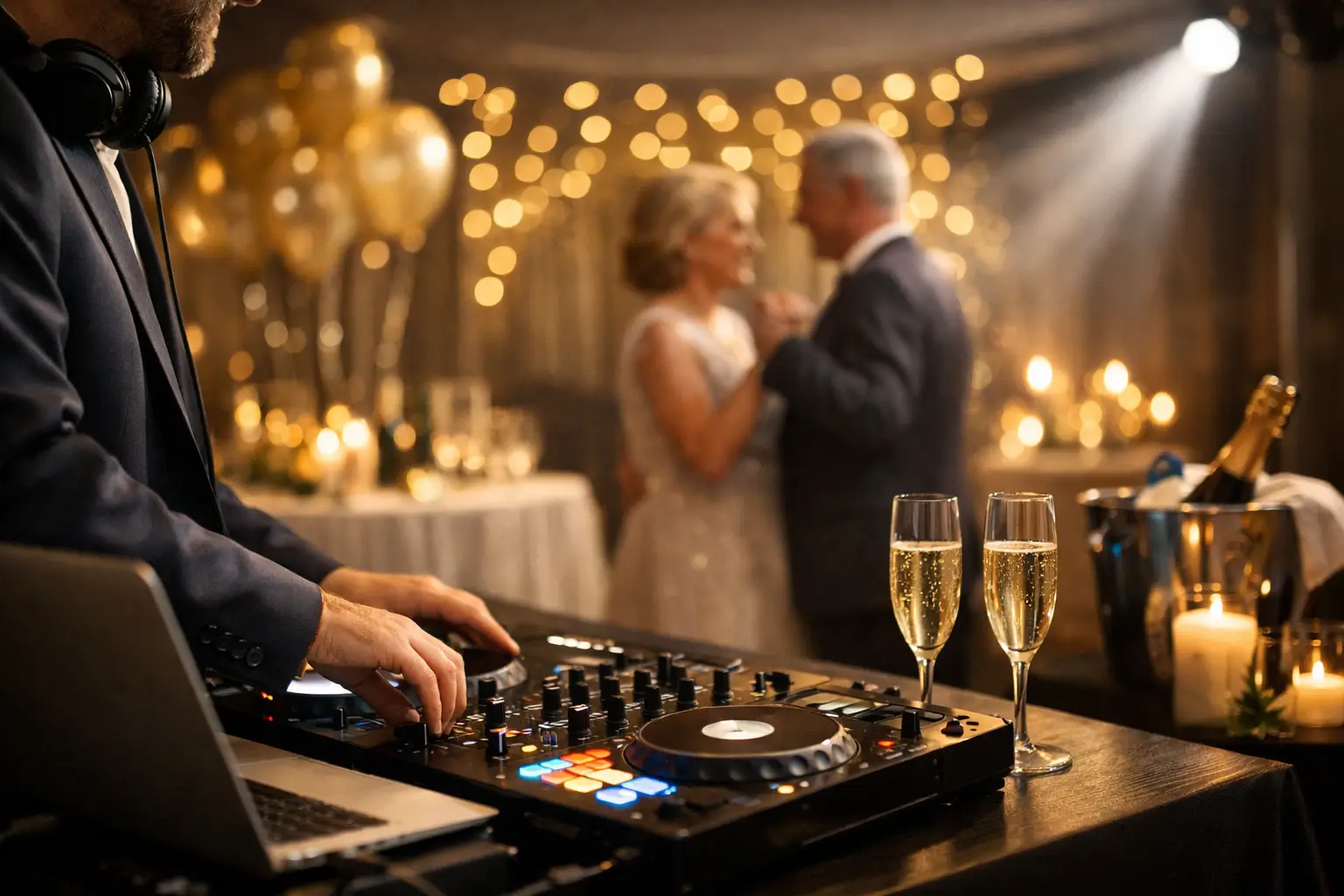
When planning music for an anniversary celebration, it's not just about a playlist with a few favorite songs. It’s about memories, shared history, and those specific moments that make a room feel just right. An anniversary thrives on people from different generations coming together – and that's precisely why the Music whether it will be a nice evening or a party that will be talked about for a long time.
Planning music for an anniversary celebration means thinking about the mood ahead of time
Many underestimate how differently music needs to function for an anniversary. For a 25th or 40th wedding anniversary, family, friends, neighbors, and colleagues often sit at the same table. There are guests who enjoy dancing and others who primarily want to have good conversations. Therefore, the music doesn't just have to be liked. It has to carry the evening.
This is exactly where typical mistakes happen. It gets too loud too early, too emotional too late, or simply too one-sided. A celebration with only the anniversary couple's favorite songs can be very personal but doesn't automatically get everyone involved. Conversely, a purely dance-oriented selection can quickly seem interchangeable. The right solution is almost always somewhere in between.
Anyone who plans professionally doesn't think in songs, but in phases. Reception, food, initial gentle movement, rising energy, dance floor, emotional highlights, and a strong conclusion – each of these stages needs its own sound.
The occasion determines the direction
Anniversaries aren't all the same. A silver Wedding anniversary has a different energy than a company anniversary or a 50th wedding anniversary in a large family circle. That's why you should first clarify what kind of evening you want to create.
If it's more elegant and relaxed, the music can initially stay stylishly in the background. If the aim is to celebrate from the start, you'll need songs that are more recognizable, warm, and energetic. For company anniversaries the challenge is often even greater because representation and entertainment come together there. The music must sound professional, but at the same time be relaxed enough to create a good atmosphere.
Therefore, the most important question is not: Which songs do we like? But rather: How should our guests feel that evening?
Guests have a say too – even if you're the host.
A good anniversary celebration is not a private headphone session. Of course, your favorite songs can have their place. But when multiple generations are celebrating, it requires a feel for the mix. The best evenings happen when as many guests as possible feel musically catered to.
That doesn't mean everything has to be arbitrary. On the contrary. A clear direction helps. For example, you can work with classics from the couple's shared past, add well-known party hits for the dance floor, and sprinkle in current songs in between that will also engage younger guests. How this music is combined is crucial.
Often, it's not the individual song that's decisive, but the transition. A song from the 80s can work brilliantly if the moment is right. But it can also fall flat if the energy wasn't built up correctly beforehand. That's precisely why it's worthwhile to see the celebration as a dramatic arc rather than a loose collection of music requests.
What music suits which phase?
At a reception, relaxed, tasteful titles work with warmth and ease. Nobody wants to be shouted at because the sound system is set to party from the first minute. During dinner, the music can create atmosphere, but never disturb conversations.
After the official part, the sensitive phase begins. Now the evening either tips into a pleasant celebratory mood or remains stiff. Here, familiar songs with positive energy that don't immediately escalate to the max are helpful. Only when the spark is there should the dance part be truly opened up.
Later, on the dance floor, recognizability, timing, and dynamics count. A good mix connects generations instead of separating them. That's exactly what makes the difference between a full dance floor and many guests who prefer to stay seated.
Musical taste is personal – mood is predictable
Many hosts worry if their music selection is good enough. That's understandable. After all, you don't want a boring evening, but something that suits you. The good news is: You don't have to pick every song yourself to make the celebration personal.
More importantly, musical guardrails need to be set. Which decades should be included? Which genres absolutely do not fit? Are there songs with special meaning? Is there a song for the first dance, a surprise for the anniversary couple, or an emotional closing moment? Such focal points give the celebration personality without making it musically too rigid.
Emotional moments are worth their weight in gold, especially for anniversaries. A song that reminds you of your wedding day, a shared classic from earlier years, or a song that the family associates with a special experience can carry the evening. But here too, timing is everything. Too many sentimental tunes in a row often take the lightheartedness out of the celebration.
Planning music for an anniversary celebration without forgetting the technology
No matter how well the music is chosen, if the sound isn't right, the entire event suffers. Too quiet is just as problematic as too loud. Too little bass on the dance floor drains the energy, while too much volume during dinner ruins the atmosphere.
This is why the technology should always match the room, the number of guests, and the schedule. You need something different in a small hall than in a large venue with a dance area, speeches, and multiple program points. You should also consider microphones for addresses or contributions from the beginning.
Another point that's often considered too late is positioning. If the music is placed incorrectly, it will sound loud at the front and weak at the back. This is tiring for guests, and even more so for the atmosphere. Therefore, good planning considers not only the music style but also how the sound reaches all areas of the room.
Playlist or DJ - what really makes sense?
Of course, you can prepare many things yourself. For small, very relaxed celebrations, a well-curated playlist might be enough. However, if the event has more dynamics, multiple age groups come together, and the dance floor plays an important role, a playlist quickly reaches its limits.
A list doesn't react to the room. It doesn't notice when conversations go on longer, when a speech is spontaneously inserted, or when a particular song suddenly draws people onto the dance floor. However, it's precisely this flexibility that often determines the success of the evening.
An experienced DJ reads the mood, slows down when necessary, and picks up the pace when the moment arises. They combine music requests with a sense of flow and ensure that transitions feel natural. This is especially valuable for anniversaries because these celebrations are often more emotional and mixed than a pure party.
I experience it again and again: hosts want security above all else. Not the worry of whether the sound works, whether the order is right, or whether the dance floor remains empty. But rather the good feeling that someone is handling the musical part with experience, heart, and intuition.
Here's how to prepare for a music discussion effectively
If you a DJ When you contact music service providers, you don't need to bring a finished song database. Clear information about the occasion, age structure, location, and the desired atmosphere of the evening is more helpful.
Also very valuable are three things: first, a short list of must-haves, second, an honest list of no-gos, and third, suggestions for special program items. These include the opening dance, speeches, honors, surprise contributions, or specific family moments. The better these key details are known, the more fittingly the evening can be musically designed.
The most common mistakes at anniversary celebrations
A common mistake is choosing music only according to one's own taste. The second is misjudging the volume. The third is a lack of flexibility. Anniversaries, in particular, often develop differently than planned. Some guests dance earlier, others take longer. Sometimes the most beautiful moment arises spontaneously and not according to the schedule.
Musical arbitrariness is also tricky. If everything is just played in a haphazard way, a real direction rarely emerges. The celebration then doesn't feel guided. On the other hand, a concept that is too rigid can seem sterile. Good music planning strikes a balance between personality and openness.
What makes an anniversary celebration unforgettable
In the end, guests don't remember every single song selection. They remember how the evening felt. Whether there was laughter, whether generations came together, whether goosebump moments had their place, and whether a festive occasion truly became a vibrant experience.
That's exactly why it's worth taking your time when it comes to music. If you want to plan music for an anniversary celebration, don't just plan the songs, but also the mood, the timing, and the heart. Because the most beautiful celebrations happen when music doesn't just play, but connects people.
And that's exactly what an anniversary should do in the end: not just remind us of shared years, but create new memories that last.
Book DJ GerreG now & secure your desired date in good time
Are you planning your wedding or another party?Then secure your DJ early! I'll be happy to accompany you from the planning stages to the last encore in the early morning hours. I'm really looking forward to your message! 🎶

🎧 More from DJ GerreG
👉 Website:
https://djgerreg.de
🎧 Spotify:
https://djgerreg.de/spotify
📸 Instagram:
https://instagram.com/djgerreg
Play button YouTube:
https://www.youtube.com/@DJGerreG
🛒 Buy songs (before release):
https://gmusiqrecords.de/shop