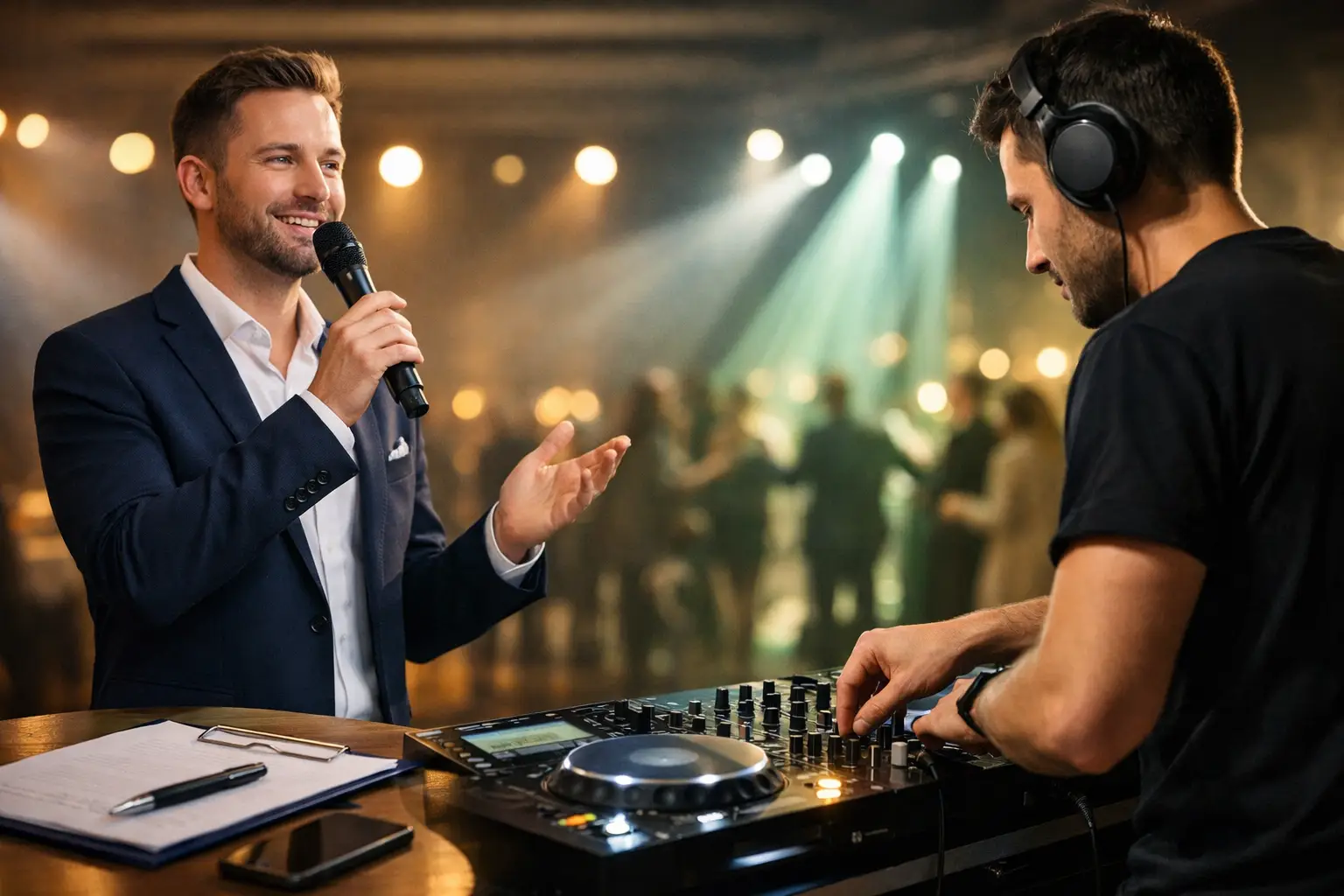
The music is perfect, the guests have arrived, the lighting is just right – and then the mood sours precisely between program items because no one is managing the space effectively. That's exactly why you should Prepare moderation for event, before the first guest raises their glass. Good moderation isn't loud, it isn't forced, and it's certainly not an end in itself. It provides direction, holds the evening together, and ensures that special moments don't just fade away.
I experience it again and again: organizers plan the menu, technology, and music down to the last detail, but when it comes to announcements, they suddenly say: "We'll figure it out on the spot." You can hear that "figure it out." And the guests notice it immediately. Who is hosting the evening? Who is announcing performances? Who is handling delays? Who strikes the right tone between festive, relaxed, and professional? When these questions are clear beforehand, an event flows noticeably more smoothly.
Why You Should Prepare Event Moderation
Moderation is far more than just a few nice sentences into the microphone. It's the common thread that turns individual program items into a coherent experience. Especially at weddings, company parties, and anniversaries, it determines whether an evening feels smooth or constantly stalls.
The biggest mistake is usually not a bad voice or a lack of quick wit. The biggest mistake is a lack of preparation. Because even a likeable person can seem insecure if names are mispronounced, processes are unclear, or transitions are clumsy. Conversely, calm, concise, and well-coordinated hosting can appear enormously professional.
It's also true: not every event needs a lot of moderation. Sometimes a few precise announcements are enough. Sometimes it needs someone who can lead charmingly, engage guests, and react to changes on the fly. It depends on the occasion, the number of guests, and the dramaturgy. Precisely for this reason, preparation is worthwhile.
The first step: Define role and style
Before texts are written, you must clarify what the moderation's task is. Should it only inform? Should it build enthusiasm? Should it be representative and elegant, or casual and approachable? A Christmas party with 300 employees needs a different tone than an emotional Small wedding celebration.
The key is that the moderation suits the event and doesn't become about self-promotion. No one books a special evening so that the announcements are the main focus. Good moderation supports the event. It doesn't push itself to the forefront.
This also includes the question of who will be the host. The best man can be very personal, but not everyone likes speaking in front of many people. A colleague from the company knows internal topics, but might not be practiced in timing. An experienced DJ or professional host brings routine, but must be seamlessly incorporated into the schedule. There is no universally right or wrong answer here – only the right person for your occasion.
Process beats improvisation
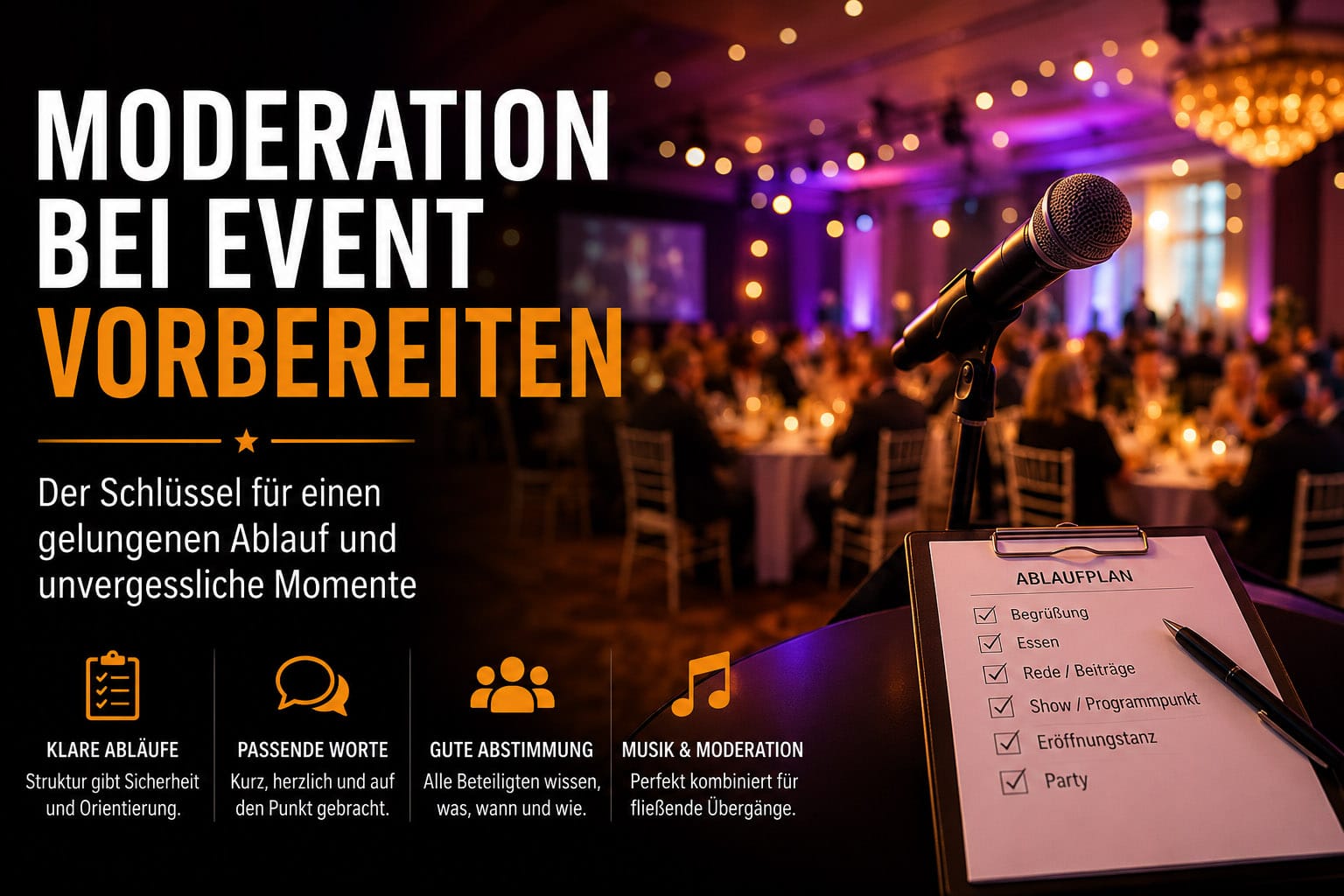
If you want to prepare for moderating an event, you first need a realistic schedule. Not a sterile minute-by-minute timetable, but a reliable framework. When do guests arrive? When is the welcome? When does the meal, award ceremony, first dance, speech, or show start? And what happens if something gets delayed?
This is precisely where theory meets practice. An event rarely runs to the second. That's normal. Therefore, the moderation shouldn't stick to the clock word for word, but rather to situations. Instead of saying Announcement X at 8:15 PM, it's often smarter to plan: After the main course, there's a brief announcement of the speech. This keeps the schedule flexible without becoming chaotic.
A simple dramaturgical structure on three levels is helpful: Arrival, Highlights, and Conclusion. Arrival is about orientation and atmosphere. Highlights require clarity, emotion, and timing. In the conclusion, moderation should decrease, allowing space for music, conversation, and mood.
Prepare text, but don't sound stiff
Many people are afraid of appearing prepared, as if spontaneity is automatically better. The opposite is often the case. Good moderation sounds relaxed because it is prepared. Not because it comes out of nowhere.
Therefore, write short moderation modules for all important points. Greetings, transitions, announcements, thank-yous, and closing remarks should be in bullet points or in concise form. No novel pages. Nobody wants to hear read-aloud essays. Short, clear sentences almost always work better.
Pay special attention to names, titles, and pronunciation. This sounds trivial, but it's one of the most common stumbling blocks. If you misannounce an honored guest or a bridal couple, you lose credibility in seconds. Therefore, check every phrasing, every title, and every sequence beforehand.
And another thing from practice: write the way people speak. If a sentence looks good on paper but stumbles when spoken, it won't be any better in the room. Read every passage aloud. Then you'll immediately notice what's too long, too stiff, or too complicated.
Technique, timing, and spatial awareness are part of it
Moderation doesn't end with the text. It stands or falls with technology and atmosphere. A good microphone, appropriate volume, and clear sound are not minor details. If guests can't understand announcements or the microphone whistles, impact is lost – no matter how good the content is.
Therefore, it should be clear before the event begins: Which microphone will be used? Who will control the volume? Is there a backup microphone? Where will the moderator be standing in the room? An announcement from the wrong location can seem unsettling or distant. Especially in larger venues, it makes a difference whether someone speaks visibly and present or disappears somewhere between the technical equipment and service staff.
Timing is just as crucial. Good moderation doesn't come too early or too late. If guests are still talking loudly, service is ongoing, or a program item isn't ready yet, even the best announcement is useless. Then, you need a feel for the moment. This intuition arises more easily when the schedule, contact persons, and signals are coordinated in advance.
The right agreements with all stakeholders
An event is never solely carried by one person. Therefore, the moderation must be coordinated with all relevant stakeholders. Depending on the occasion, these include witnesses, the venue, catering, technical staff, the photographer, event management, speakers, or artists.
This coordination is invaluable, especially for celebrations with multiple program items. When the photographer knows when something will be announced, they won't miss any key moments. When the service staff knows when an announcement is coming, no dishes will clatter at that moment. When the DJ knows when a speech is ending, music can start precisely on cue. This is exactly how an event creates a seamless experience.
Those who only plan roughly here often pay with unnecessary unrest. Too many spontaneous calls, last-minute changes in the room, and hectic questions cost energy. A short, clear preliminary check with all key people is better. Not endless, but binding.
What makes for good event moderation
The strongest moderation is rarely the most noticeable. It is clear, warm, and appropriate to the audience. At a wedding, it can be emotional, but not cheesy. At a company party, professional, but not cold. At an anniversary, personal, but not rambling.
Less is often more. Guests want to feel comfortable and go along with things, not be lectured. That's why announcements should get straight to the point. A short, charming transition is usually more effective than a long monologue. And if a moment is allowed to speak for itself, then you shouldn't talk it to death.
It's also important to be able to react spontaneously. A speaker is missing, a program item is postponed, the meal is taking longer – these things happen. That's where experience shows. Someone who is prepared stays calm and finds a suitable transition without appearing flustered. That's exactly what gives confidence.
Common preparation mistakes
A common mistake is confusing moderation and entertainment. Not every announcement needs a joke, not every transition needs grand words. Another mistake is an overly internal language. What is clear within the organizational team is not automatically understood by the audience.
It also becomes problematic when too many people want to spontaneously go to the microphone. This can be emotionally beautiful, but it quickly causes unrest. Prior agreements help here: Who speaks, when, for how long, and with what goal? This doesn't take away anyone's personality, but rather protects the flow.
And then there's the length. Many moderations lose their impact because they're too long. At an event, every extra minute feels longer than expected. Keep announcements concise to maintain energy and attention in the room.
When DJ and hosting work together
An event becomes particularly strong when music and moderation don't just run side-by-side, but work together. Then there's no break between announcement and mood, but a smooth transition. That's often the difference between a nicely organized party and a truly captivating one.
An experienced DJ with hosting experience can handle a lot here because they read the room, feel the audience, and purposefully connect music with words. With DJ GerreG, this very sense for flow, atmosphere, and timing has been part of their practice for years. Not as a show for show's sake, but so that your evening feels secure, welcoming, and unforgettable.
In the end, it's not about saying as much as possible. It's about saying the right thing at the right moment – and giving everything else the space it deserves. When your moderation is prepared, your guests will primarily feel one thing: This evening has heart, structure, and precisely the security needed for genuine goosebump moments.
Book DJ GerreG now & secure your desired date in good time
Are you planning your wedding or another party?Then secure your DJ early! I'll be happy to accompany you from the planning stages to the last encore in the early morning hours. I'm really looking forward to your message! 🎶

🎧 More from DJ GerreG
👉 Website:
https://djgerreg.de
🎧 Spotify:
https://djgerreg.de/spotify
📸 Instagram:
https://instagram.com/djgerreg
Play button YouTube:
https://www.youtube.com/@DJGerreG
🛒 Buy songs (before release):
https://gmusiqrecords.de/shop