The champagne reception often determines the mood of a wedding faster than many couples think. This is where it becomes clear whether the day feels like waiting and organizing, or whether lightness emerges from the first glass. When it comes to the topic Reception Music Wedding If you're only thinking about quiet background music, you're missing a big opportunity.
Why the music at a sparkling wine reception is more than just background
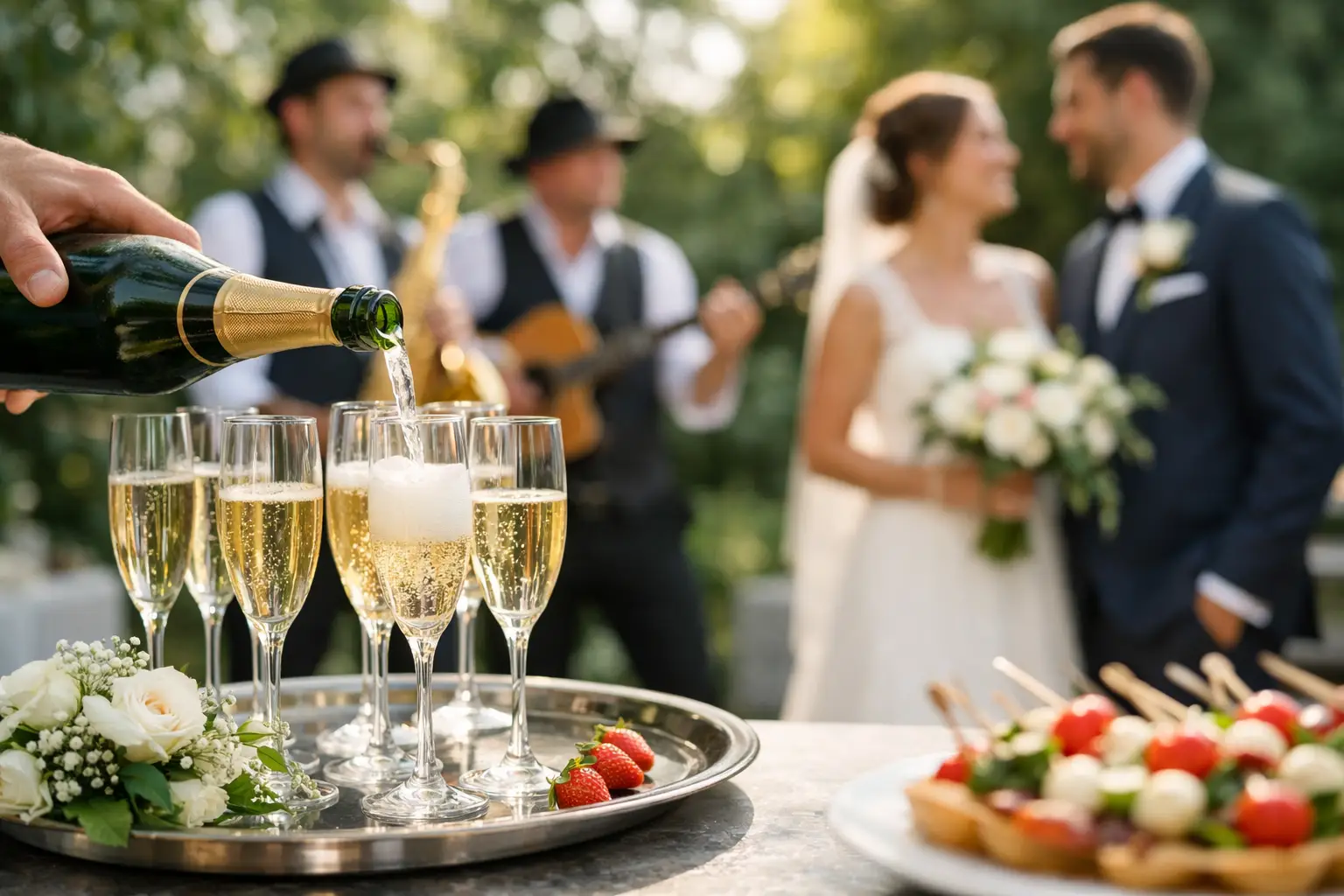
The champagne reception is not a filler between the ceremony and the party. It's the first moment where everyone can take a breath, congratulate, toast, and truly soak in the atmosphere of your wedding. Music gives direction to this moment.
Without music, many receptions feel surprisingly sober. Conversations are harder to start, small pauses become noticeably uncomfortable, and the room feels empty faster, even with many guests. With the right accompaniment, however, warmth is immediately created. Guests feel welcomed, and the transition from the emotional ceremony to a casual celebration flows much more naturally.
Right after a free wedding ceremony or the registry office, the emotions are still raw. That's exactly why the music shouldn't overwhelm this moment, but also not detract from it. It's about sensitivity. Not too loud, not arbitrary, not cold.
Reception music wedding – what mood really fits?
Many couples first say, „Please, relaxing.“ That's a good start, but not yet a real musical direction. Relaxing can be elegant, modern, summery, soulful, or easy to dance to. What's crucial is what fits you, your guests, and the day's schedule.
For a stylish wedding in a classic venue, soul, lounge, acoustic pop versions, or select sophisticated classics often work very well. For a casual garden wedding, something brighter, lighter, and more rhythmic can be suitable. If there are many international guests, a broader selection is worthwhile so that more people feel emotionally connected.
What I always see in practice: Music that's too quiet drains energy from the reception. Music that's too noticeable takes up space for conversations. The right balance lies somewhere in between. Guests should be able to talk, laugh, toast, and still feel carried by the music.
The most common mistakes in music selection
The biggest mistake is leaving the champagne reception entirely up to chance musically. Simply playing any playlist might sound uncomplicated at first, but it often leads to breaks. Suddenly, a song comes on that's too dominant, doesn't fit lyrically, or spoils the mood.
A second mistake is incorrect volume. Every detail counts, especially during reception. If the music is too quiet, it seems like an afterthought. If it's too loud, guests have to shout over each other. This doesn't create a relaxed atmosphere, but rather an effort.
The timing is also often underestimated. Music shouldn't start only when the first guests are already standing around with drinks in their hands. The reception needs an acoustic foundation from the very first moment. Otherwise, that typical feeling of idleness arises.
And then there's the question of stylistic incoherence. If at the reception only generic chart music plays, which would be better suited for the dance floor later, the day will lack a clear narrative arc. Good wedding music builds on itself. The champagne reception doesn't need to be a party yet. It should create anticipation for more.
Live DJ or playlist – what makes more sense for a champagne reception?
That depends on your standards. A playlist is cheaper and looks simple on paper. It can work if it's really curated well, plays back reliably technically, and someone is keeping an eye on volume, transitions, and atmosphere. But that's often where it fails.
A DJ brings control and a feel for the mood to a champagne reception. I can react spontaneously if the atmosphere needs to become more elegant, relaxed, or lively. I can see if guests are in deep conversation, if the reception is picking up steam, or if a bit more musical pulse would be beneficial. This real-time adjustment makes a big difference.
In addition, there's technical security. No ad blockers, no connection problems, no embarrassing song changes at the wrong time. Especially at weddings, where every moment happens only once, that's worth more than many initially suspect.
Which music genres work well for a champagne reception
There isn't one perfect solution, but there are styles that have proven particularly successful. Very popular are tasteful pop, soul, lounge, chillout, subtle deep house, acoustic covers, and selected classics from several decades. This allows for a stylish, warm, and modern reception.
If you like it emotional and high-quality, songs with recognizability can be powerful – but in versions that carry the moment and don't hijack it. A good reception song doesn't have to make everyone want to sing along. It should create atmosphere.
For younger crowds, the champagne reception can afford to have a bit more groove. With mixed age groups, a broader musical style is often wiser. And for very elegant weddings, restraint usually has more impact than activism. It's like good lighting: when it's right, you don't immediately notice why – but you feel it.
How personal can the music be?
Very personal, but not too private. Your shared favorite songs can work wonderfully if they support the character of the reception. Less sensible are titles that only have meaning for you but are difficult for guests to access or that abruptly break the mood.
I always recommend working with a clear direction: What should the reception evoke? Relaxation, style, a summer feeling, elegance, lightness? This will lead to a more reliable music selection than a random collection of individual favorite songs.
Technology, volume, and workflow must work together.
Cocktail reception music for a wedding is not just a matter of songs. Technology, placement, and timing are at least as important. Music sounds different in a courtyard than in a ballroom. Speakers have a different effect on a terrace than in a barn. Wind, foot traffic, speeches, and service noise further alter the impact.
Therefore, the sound system should be planned so that the music reaches the room evenly, without overpowering individual groups. Guests on the periphery should not be acoustically left behind, and guests near the equipment should be able to converse normally. This sounds obvious, but it is surprisingly often implemented incorrectly.
The sequence of events also plays a role. Are there congratulations immediately after the ceremony? Will group photos be taken? Is a change of location planned? Will the reception take place outdoors and the dinner indoors? The more clearly these points are coordinated in advance, the better the music can connect the individual phases.
How loud should the music be at a reception?
Loud enough to create ambiance. Quiet enough to keep conversations easy. This precise balance is crucial. There's no fixed numerical value for this because space, number of guests, and the situation all vary. But there's a clear feeling: no one should have to strain to have a normal conversation.
If greetings, short speeches, or spontaneous moments arise repeatedly during the reception, the music needs to be able to be lowered flexibly. This is one of the reasons why a live-accompanied reception appears so much more polished than a rigid playlist.
The champagne reception as a bridge to the later celebration
A good wedding has a narrative arc. It doesn't start at zero and then suddenly jump to a hundred at night. The champagne reception is the first musical bridge in this arc.
If the right touch is already evident here, the whole day feels more complete. Guests unconsciously notice: this celebration is well thought out. The music fits. The flow feels secure. This is exactly how trust in the evening is built – and later, the willingness to actually hit the dance floor.
I often find that a successful mood at the reception noticeably sets the stage for the evening. The guests are more open, relaxed, and quicker. in a celebratory mood. It's not about going full throttle from the first toast. It's about making heart, style, and energy palpable from the very first moment.
How to make the right decision for your wedding
When planning the music for the champagne reception, don't just ask: What songs do we like? Instead, ask: How do we want our guests to feel in this moment? That's where the right selection begins.
Think about your location, the age structure, the length of the reception, and the transition to further procedure. A 30-minute reception after the civil ceremony requires a different flow than an extended reception in the countryside with a photo session and many conversations.
If you value security, atmosphere, and a cohesive flow, professional guidance is almost always worthwhile. Especially because the champagne reception is often underestimated, the right music can do more than just contribute to the overall feel of your wedding. That's exactly part of DJ GerreG's job: not just playing songs, but accompanying moments in such a way that they become memorable.
Your champagne reception doesn't have to be spectacular. But it should feel right from the very first note – warm, stylish, and full of anticipation for everything that follows.
Book DJ GerreG now & secure your desired date in good time
Are you planning your wedding or another party?Then secure your DJ early! I'll be happy to accompany you from the planning stages to the last encore in the early morning hours. I'm really looking forward to your message! 🎶

🎧 More from DJ GerreG
👉 Website:
https://djgerreg.de
🎧 Spotify:
https://djgerreg.de/spotify
📸 Instagram:
https://instagram.com/djgerreg
Play button YouTube:
https://www.youtube.com/@DJGerreG
🛒 Buy songs (before release):
https://gmusiqrecords.de/shop