The question When does dance music start at a wedding At first, it sounds simple. In practice, however, this exact moment often determines whether the evening has a slow start or whether the dance floor gets going with heart, timing, and energy. I've experienced it time and time again over many years: it's not the time alone that makes the difference, but the right moment.
When does dance music really start at a wedding?
The honest answer is: mostly between 8:30 PM and 10:00 PM. Anything before that can work, but it has to fit the dynamics of your wedding. Anything significantly later often takes the momentum out of the evening because guests then become tired or have settled into fixed conversation groups.
Many couples initially think in terms of timing. I tend to think in terms of mood. As long as people are eating, chatting, or service staff are still constantly attending the tables, dance music rarely has its full effect. Once dinner is finished, the main program points are done, and the guests mentally switch into party mode, that's the ideal time window.
This is precisely why there isn't a rigid rule like „the party starts at 9 PM.“ Wedding is not a switch. It lives on transitions. Good dance music doesn't start abruptly, but rather cleanly builds the evening's energy.
The right time depends on the process.
Whether the dance floor opens early or later almost always has to do with your daily schedule. If your wedding ceremony begins in the afternoon and is followed by a champagne reception, photos, dinner, and perhaps a few contributions from family and friends, then a party start before 8:30 PM rarely makes sense.
It looks different if you eat very early, have only a few program items, and consciously want a long party evening. Then the dance music can already start around 8 p.m. This often works well, especially for smaller, casual parties, because the distances are shorter and the transitions are more natural.
It gets more difficult when too much is packed into the evening. A speech here, a game there, cake afterwards, then a surprise contribution – and suddenly it's 10:30 PM. Then the DJ not only has to play music but first has to build up energy again. That's possible, but it's unnecessarily difficult.
Typical Times at a Glance
With many Weddings Does it go something like this: After dinner, there's a short, quiet period, followed by the first dance or a deliberately chosen musical moment, and then the dance floor opens up. In many cases, this point falls between 9:00 PM and 9:30 PM. This is often a very good window because guests have arrived, had their fill, and are ready for the next part of the evening.
If children are present or you have many older guests, the start can certainly be a little earlier. This way, these guests will still experience an active, lively part of the evening. If, on the other hand, you're planning a wedding with a club atmosphere and a younger crowd, a later peak can work – but even then, musical excitement should be built up beforehand.
Why early dance music often doesn't stick
I understand the desire of many couples very well: finally celebrating, finally dancing, finally partying. But when the music is turned up to full energy too early, often there's just a beautiful lighting system in front of an empty space at first. Not because your guests aren't in the mood, but because they're not ready yet.
During the meal, most people are still talking, engaged in organizational matters, or simply in enjoyment mode. Jumping up to dance right after the main course doesn't come naturally for most guests. There's a missing mental shift from „We're sitting together“ to „Now we're really celebrating.“.
Premature dance music can also rob valuable dynamics. If the party starts before everyone is mentally ready, the first strong songs fizzle out. It's better to let the anticipation build visibly and then introduce the music strategically.
Why starting too late is also risky
On the other hand, starting the party too late is one of the most common brakes on weddings. When everything gets pushed back, the energy eventually shifts. Some guests leave earlier, others become sluggish, and the group loses its shared moment.
It is precisely at weddings that timing is sensitive, because the dance floor thrives on a sense of community. If you delay the start for too long, the group will fragment. Then some people will be outside, others at the bar, and still others will be stuck at their tables. Making one big party out of many small islands requires considerably more experience and sensitivity.
Therefore, my clear advice: It's better to plan a realistic, somewhat more compact evening schedule and give the dance music enough time. A great celebration needs breathing room.
The first dance as a natural starting point
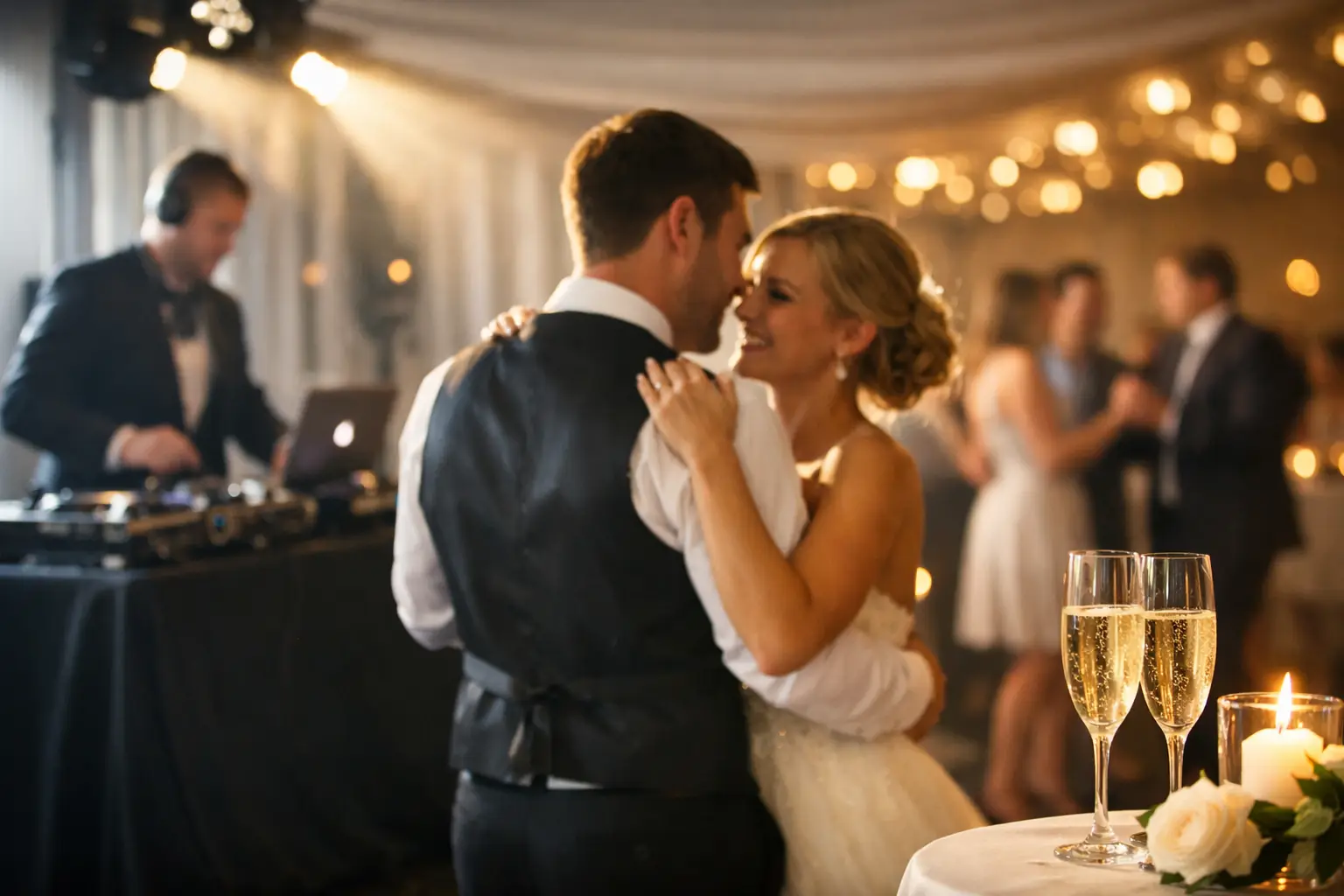
For many couples, the wedding dance the official kickoff to the dance music. That's classic, emotional, and often just right. After your song, the dance floor can be opened naturally – first with the best man, parents, and friends, then with more tempo for everyone.
What's important is less whether your song is traditional, modern, or surprising. What matters is what happens afterward. If there's a lull after the first dance because the equipment needs to be rearranged, the cake served, or there's a long discussion, this moment loses a lot of its impact.
The wedding dance works best when it doesn't stand alone, but transitions directly into the party portion. That's exactly where experience with the flow of events is evident. Guests don't need a hard restart, but rather a pull onto the dance floor.
What should happen after the wedding dance
After the opening dance, the music shouldn't drop back to zero. A good transition first brings onto the dance floor those who will definitely join in, and then gradually expands the energy. This can include well-known classics, soulful sing-along songs, or rhythmic tunes that work across generations.
The art lies in not starting at maximum tempo immediately, yet still not creating a lull. A full dance floor rarely happens by chance. It happens when music, flow, and the audience come together seamlessly.
What role guests, age, and mood play
The answer to when dance music should start at a wedding always depends on your guests. A group with many friends who love to dance, a clearly celebratory mood, and little in the way of a structured program is often ready quickly. A mixed wedding party with grandparents, children, those who have traveled far, and a long day usually needs a more conscious approach.
Therefore, I recommend that couples not only state their desired start time but also honestly consider their guest structure. Who gets in the mood early? Who needs more time? Who will be on the dance floor at the beginning? If these questions are clarified in advance, the transition can be planned much more smoothly.
Especially at multi-generational weddings, it's worth starting in a way that doesn't immediately target only the youngest guests. If the first half hour captures as many people as possible, the sense of community grows. After that, the evening can still become more modern, impactful, and club-like.
This is how you plan a stress-free party start
It's best if you think of the evening not in rigid minutes, but in a meaningful order. Eating should ideally be completed. Speeches and interludes should be grouped together and not broken up throughout the course. Wedding dance needs a clear space. And the dance music needs a clear path afterward.
If you coordinate your vendors, best man, and venue in a timely manner, you'll avoid typical roadblocks. Nothing drains more energy than unplanned interruptions in the middle of the party setup. A good DJ will address these points beforehand, because that's often where it's decided whether your celebration flows or stumbles.
Who in Northern Germany, approximately Hamburg, By the way, whoever celebrates or experiences something often has a relaxed, but not automatically early, start to the party. Especially where guests like to sit together for a long time and have good conversations, it requires a keen sense for the right moment to switch gears. That moment is more important than any fixed time.
Practical advice
If you ask me when dance music should start at a wedding, I'd say: as early as possible, but only when the guests are truly ready. That sounds like a contradiction, but in reality, it's the best formula for a full dance floor. Don't rush, but don't dawdle either.
A good goal is usually to clearly kick off the official party sometime between 9:00 PM and 9:30 PM. If your schedule deviates from that, it's completely fine – as long as the evening still maintains excitement and doesn't break down into a lot of small interruptions.
In the end, it's not about hitting the perfect time. It's about capturing the moment when a beautiful wedding turns into an unforgettable celebration. That's exactly where dance music doesn't just start—it makes a statement, and suddenly the whole mood is there.
Book DJ GerreG now & secure your desired date in good time
Are you planning your wedding or another party?Then secure your DJ early! I'll be happy to accompany you from the planning stages to the last encore in the early morning hours. I'm really looking forward to your message! 🎶

🎧 More from DJ GerreG
👉 Website:
https://djgerreg.de
🎧 Spotify:
https://djgerreg.de/spotify
📸 Instagram:
https://instagram.com/djgerreg
Play button YouTube:
https://www.youtube.com/@DJGerreG
🛒 Buy songs (before release):
https://gmusiqrecords.de/shop