
If you are looking for a real Example wedding with DJ accompaniment When you're looking for advice, you usually don't want to read theory. You want to know how an evening like that can actually unfold, when certain music works, and why some parties take off right from the start, while others don't quite get going despite a beautiful location. That's exactly what this is about – not as a rigid pattern, but as a practical illustration of how a wedding with good DJ accompaniment can become lively, emotional, and danceable.
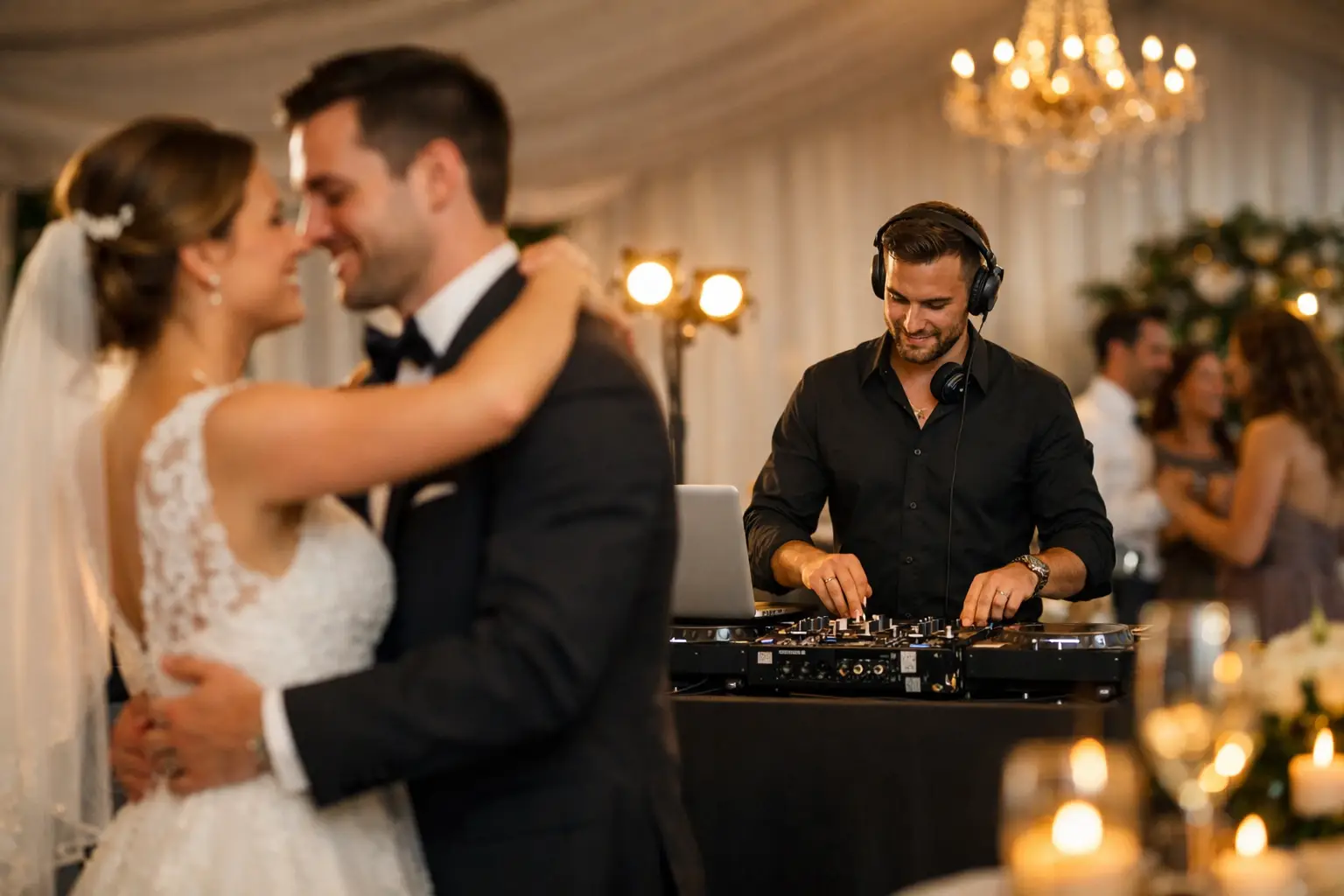
A sample wedding with DJ accompaniment from practice
Imagine a wedding with around 85 guests. The group is a colorful mix: friends in their early 30s, family between 50 and 75, a few children, and colleagues who enjoy celebrating in the evening. This exact mix is typical – and this is precisely where a DJ who can not only play songs but also read the room becomes so important.
The civil ceremony ends late in the afternoon. Even before the first drink is served, the... background music. No loud party, no random playlist, but warm, stylish music that creates atmosphere and carries conversations without overpowering them. This sounds like a small detail, but it's often the first point where guests feel whether a celebration is being built with heart.
The champagne reception isn't about appearing as modern or cool as possible. It's about creating a sense of lightness. Soul, relaxed pop classics, subtle house elements, or well-known love songs, used sparingly, often work better than music that demands too much attention. The advantage of a real DJ accompaniment is obvious here: The music doesn't just play through, it adapts to tempo, volume, and mood.
Why Timing Matters More Than the Perfect Song List
Many bridal couples start with the question: Which songs are absolutely essential? The better question is often: When should which moment take effect? A good example of a wedding with DJ accompaniment quickly shows that timing is almost more important than individual tracks.
When guests are invited into the hall, a musical transition is needed to grab their attention. For the bridal party's entrance, the music can be uplifting, but should not feel artificial. During dinner, restraint is key. Anyone who switches to party mode too early here will burn up energy that will be needed later on the dance floor.
An experienced DJ builds tension. He doesn't put himself at the center of attention, but rather ensures that the evening's highlights have a greater impact. This applies to the first dance as much as to planned events, speeches, or spontaneous surprises from friends and family.
The reception
In our example, the reception begins around 4:30 PM. Guests arrive, offer congratulations, toast, and move between the terrace and the hall. Musical flexibility is worth its weight in gold here. As soon as a group stands before the bridal couple, the volume must not be disruptive. As soon as the room opens up again, the music can once again carry a bit more.
The dinner
The meal starts around 6:30 PM. Many underestimate this part. If the dinner isn't accompanied by good music, the mood easily shifts in two directions: either it feels like a restaurant, or it becomes restless and random. Good dinner music holds the evening together. It provides warmth without being pushy.
Between courses, there are speeches from the father, best man, and the bridal couple. Here, the DJ is not only responsible for music but also for smooth transitions. Microphones need to be ready, volumes adjusted, and the switch between speeches and music must flow naturally. Hosts immediately feel this assurance – and it's incredibly relaxing.
The moment when a celebration truly becomes a party
Around 9:15 PM, the moment many have been waiting for has arrived. The Opening dance It stands. In this example, the couple chooses a song that has personal meaning for both of them. No show act, no choreography, but an honest moment. And that's exactly why it works.
After about a minute and a half, parents and wedding party are brought in, and shortly thereafter the dance floor opens up for everyone. This is often the smartest way. Those who make the first dance too long or let a pause arise afterward lose energy unnecessarily. Conversely, those who transition directly to the full floor capitalize on the emotion of the moment.
A good DJ doesn't just blindly rely on the wildest party hits these days. They start with songs that work across generations and immediately build trust. Well-known classics, strong singalong moments, danceable tracks with positive energy. Only when the dance floor is full do they gradually personalize. That's precisely how momentum is created.
What really works on the dance floor
The greatest strength of a DJ's accompanying performance is rarely shown in the technique and almost always in reading the audience. In our example, the first 45 minutes of the party are crucial. If the dance floor is then established, the evening usually carries itself. If not, fine-tuning is required.
Here's where the difference between a wish list and party reality shows. Of course, favorite songs can have their place. But not every favorite is automatically a good floor filler. Some tracks are emotionally important, but drag the energy down. Other songs that seem simple on paper create precisely those moments where three generations suddenly dance together. And it's these images that stick.
An experienced wedding DJ therefore doesn't work according to a rigid sequence. He observes, tests, reacts. If a group is just coming back from the bar, a familiar hit might be needed again. If the dance floor is getting younger, it can become more modern and energetic. If the mood is at its peak, you shouldn't destroy it with an abrupt change of style.
The musical balance
With mixed weddings, the art often lies in the transitions. 90s hits, current charts, disco classics, German party anthems, soul, dance, and a few personal favorites can go wonderfully together – if the transitions are right. Chaos only arises when the music isn't managed.
In our example, around 10:30 PM, there's a phase with well-known party classics that almost everyone joins in on. Later, more modern tracks follow for the younger guests. Just before midnight, there's another block of true evergreen hits because that's exactly when many people who were mostly watching before come back to the dance floor. This is no coincidence. This is experience.
An example wedding with DJ accompaniment is also called: security in the process
Many people first think of music when they think of DJ accompaniment. Understandable, but a short-sighted view. A well-accompanied wedding reception also thrives on structure. Who announces the first dance? When is the right moment for the cake cutting? How is a surprise performance integrated without losing the flow?
One DJ with event routine Keep these points in mind. Not dominant, but supportive. This helps above all Newlyweds, who don't want to direct their own day. Because nothing kills the mood faster than uncertainty in the schedule.
There are weddings where spontaneous changes are necessary. The food is delayed, a speech is moved up, the weather changes the plan. Then you don't need a rigid template, but someone who radiates calmness and can switch gears musically at a moment's notice. That's precisely where the great added value of professional support lies.
Where the differences truly lie
Of course, you can also play music via a playlist. That might be enough for a small, casual setting. But with a wedding that includes emotional highlights, different age groups, and long time slots, a playlist quickly reaches its limits. It doesn't react. It doesn't sense when guests are receptive, when a song comes too early, or when a moment needs more feeling.
A DJ costs more than a speaker with prepared music. That's the honest truth. But for that, you don't just get songs, you get guidance, feel for the room, timing, hosting confidence, and often the crucial difference between a nice evening and a packed dance floor. So, it really depends on what's important to you for your wedding.
If you wish for an evening that feels personal yet is professionally led, this decision is almost always worthwhile. Especially when memories are meant to be made not just in photos, but right in the middle of the dance floor.
What you can take away from this example for your own wedding
The most important lesson from any good example of a wedding with DJ accompaniment is simple: It's not the length of the song list that matters, but the interplay of people, moments, and music. A wedding works particularly well when the evening unfolds naturally yet is still confidently guided.
Don't just plan your favorite songs, but also the energy of the evening. Consider when intimacy is called for, when lightness is appropriate, and when the party should really kick off. The clearer these points are, the more personalized the musical accompaniment can become.
When I cover weddings, It's never just about playing music for me. It's about making memories tangible, bringing people together, and guiding the evening so you can let loose. That's when the kind of celebration is created that guests talk about for a long time to come.
In the end, your wedding shouldn't sound like everyone else's, but should feel like it's yours – with heart, with energy, and with just the right moment on the dance floor.
Book DJ GerreG now & secure your desired date in good time
Are you planning your wedding or another party?Then secure your DJ early! I'll be happy to accompany you from the planning stages to the last encore in the early morning hours. I'm really looking forward to your message! 🎶

🎧 More from DJ GerreG
👉 Website:
https://djgerreg.de
🎧 Spotify:
https://djgerreg.de/spotify
📸 Instagram:
https://instagram.com/djgerreg
Play button YouTube:
https://www.youtube.com/@DJGerreG
🛒 Buy songs (before release):
https://gmusiqrecords.de/shop