
If at a party the parents start humming along, then the friends jump up, and later even the grandparents go back to the dance floor, one thing is clear: Music for mixed-age guests doesn't work by chance. It arises from experience, sensitivity, and the right feel for the moment. This is often exactly the difference between a nice playlist and a party that people will talk about for a long time.
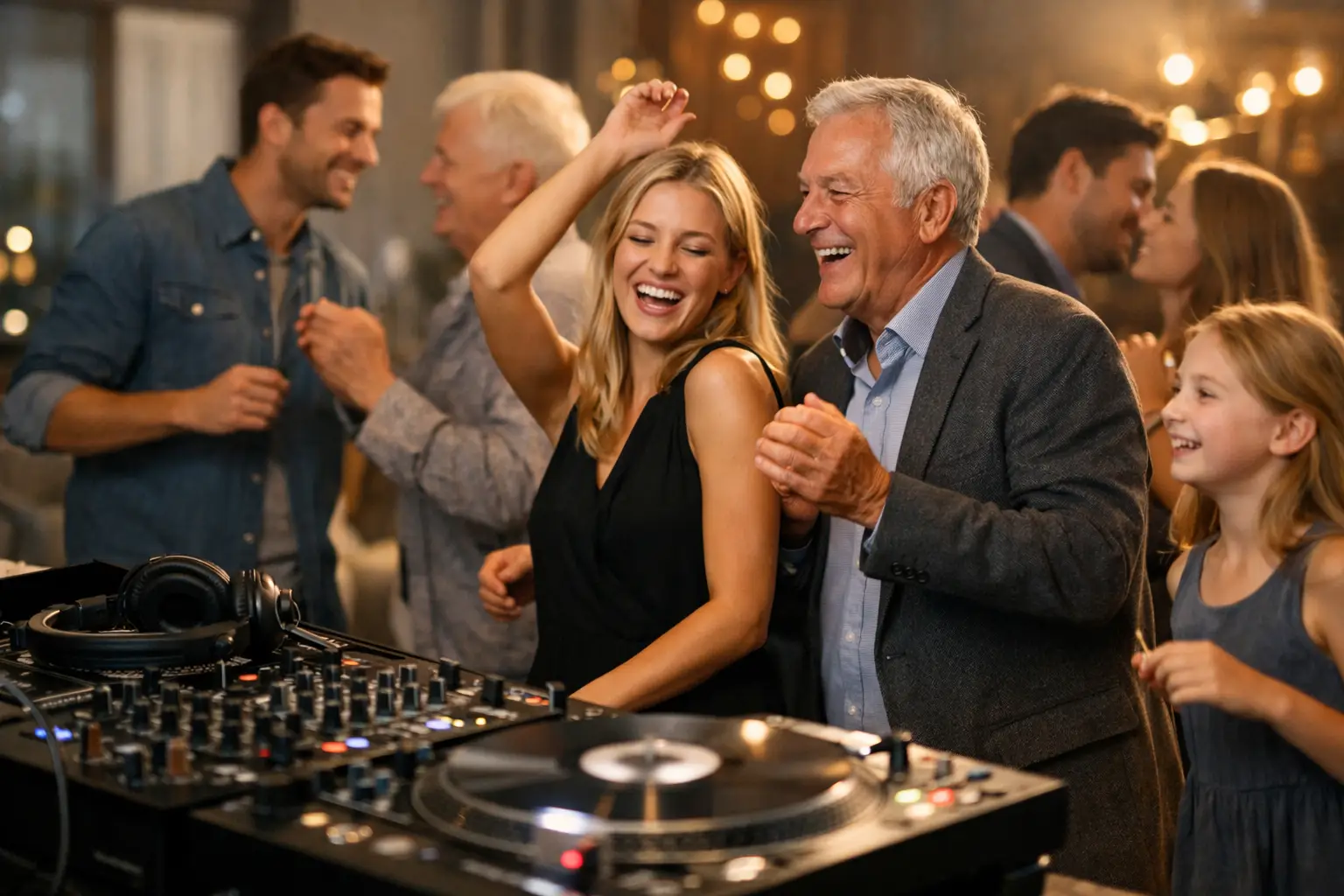
Why music for mixed-age guests is often underestimated
Many hosts first think of their favorite songs. That's understandable, after all, the celebration is meant to be personal. However, a wedding, an anniversary, or a company party almost never has a uniform audience. Different generations, different musical preferences, and often very different expectations meet there.
Some love disco classics, others celebrate the 90s, and some want current charts or German pop. On top of that, there are guests who like to dance and those who are more easily reached by familiar melodies. Anyone who plans too one-dimensionally risks a dip in the mood. The dance floor won't be shared, but experienced in layers – and that's exactly what drains energy.
As a DJ for many years, I've seen that it's not the individual song that matters, but the overall flow of the evening. It's not about giving every guest their exact song request. It's about building musical bridges so that as many guests as possible feel engaged.
What age-mixed parties really need musically
The most important point is recognition. People especially enjoy dancing to music they immediately understand emotionally. At parties with mixed age groups, this doesn't automatically mean oldies. It means familiar songs, strong choruses, clear grooves, and songs that work across generations.
A good music mix rarely stays within a single decade. It connects, for example, soul and disco with 80s, 90s, party classics, current hits, and strategically placed schlager or rock tracks – depending on what suits the audience. The transition is crucial in this process. If there are abrupt jumps between different musical styles, the party loses its flow.
Timing is just as important. A song that is too early at 8:30 PM might be just right at 11:15 PM. Many mistakes don't come from bad songs, but from bad timing. Therefore, good music for a mixed-age audience depends on the order, the arc of excitement, and reading the room.
The biggest trap: Only young or only nostalgic
Some parties lean in one direction because hosts over-control them out of consideration. Either the playlist becomes too modern so it doesn't seem dated, or too nostalgic so the older guests don't feel excluded. Both are rarely ideal.
Too much modern music can create distance if large parts of the audience have no connection to it. Too much nostalgia, on the other hand, can slow down the evening early on, especially if younger guests only really get into it later. The best solution almost always lies somewhere in between – with a clear direction, but without a rigid concept.
Here's how I plan music for mixed-age guests in practice.
The playlist isn't the starting point, the audience is. I always ask: Who's celebrating here, really? What are the age ranges of the key groups? Are there international guests? Are there more dancers, or people who enjoy themselves and only start grooving to the right songs? Are there any no-gos, family classics, or songs with personal meaning?
These answers create a musical framework. At a wedding, the start can be stylish and somewhat broader, allowing space for conversations, food, and initial emotional moments. Later, the energy can grow. Then, familiar party anthems that connect generations can help before the music is broadened more specifically.
For anniversaries It often makes sense to indirectly consider the couple's life story. What music shaped their youth? What songs do the children and grandchildren also know? Strong moments arise precisely there, because memory and the present come together.
At company parties The task is a bit different. This is less about private memories and more about a mix that brings together different age groups and tastes in a professional setting. This usually means: broadly positioned, audience-friendly, without experiments for their own sake.
The common thread instead of a wish-concert chaos
Music requests are part of many celebrations. I think that's fundamentally good, as long as they are incorporated with feeling. Because a celebration doesn't gain anything by playing every wish indiscriminately. It gains through a common thread.
If a DJ implements every request immediately, stylistic breaks quickly emerge. A soul classic is suddenly followed by "Ballermann" (a German term for a specific type of party music), then a rock number, and then a current club track. Individual guests are briefly pleased, but the collective energy suffers. It's better to incorporate requests appropriately into the flow – then guests feel recognized without the mood falling apart.
What music styles often work particularly well
There's no universal formula, but certain genres perform exceptionally well at mixed-age parties. These include disco and soul with clear danceability, strong 80s hits with high recognition value, 90s party anthems, select German classics, funk, pop classics, and current songs that aren't only known by a young target audience.
Schlager can work too – but not automatically and not always in large doses. It depends heavily on the audience. At one party, it's the emotional icebreaker; at another, it's just a brief interlude. That's precisely why experience is so valuable. Not every full room wants the same thing, and not every generation reacts the same.
Rock is similar. A few iconic tracks can make a dance floor explode. Too much of it, however, can also divide it depending on the audience. Good music for a mixed-age crowd, therefore, isn't a rigid genre list but a dynamic interplay of familiarity, energy, and tact.
Why the DJ is more than just a song provider
It's precisely with mixed audiences that the importance of an experienced DJ really shows. A playlist She can collect titles. But she cannot observe if the table with the aunts is currently thawing, if the wedding party's friends need their moment now, or if a musical change should wait three more songs.
A DJ works live with the mood. They recognize when a classic is needed as a connecting element and when modern energy can take over. They see which guests need to be gently brought onto the dance floor and when the dance floor is ready to get really going. This is not by chance, nor is it a trick. It's practice, people skills, and timing.
That's exactly why I don't just talk about genres before a celebration, but about the desired effect. What should the evening evoke? Should it start out elegant and relaxed? Should it quickly transition into a party atmosphere? Should it stay family-oriented? Should it become more international? Whoever answers these questions clearly won't get just any background music, but a real concept for the atmosphere.
Music for mixed-age guests also means safety
Many people underestimate how calming a coherent music concept is for hosts. When you know the music isn't left to chance, you celebrate differently. You don't have to manage the balance between generations yourself, resolve discussions about song sequences, or hope the mood will develop on its own.
A lot is emotionally at stake on these evenings, especially at weddings and large family celebrations. No one wants to experience groups drifting apart or the dance floor never really getting going. Music isn't just background noise. It connects people, unlocks memories, and creates the very images that will remain later.
Whoever is planning a celebration with guests between the ages of 20 and 80 doesn't need a musical mishmash. They need an evening that engages everyone without being generic. If this is achieved, different generations won't just dance next to each other. They will truly celebrate together.
I keep experiencing these moments over and over: when a song comes on where everyone suddenly smiles, gets up, and a shared feeling emerges. That's what matters. Not a long playlist, but the right music at the right time for the right people. If you consider that for your celebration, half the mood is already won.
Book DJ GerreG now & secure your desired date in good time
Are you planning your wedding or another party?Then secure your DJ early! I'll be happy to accompany you from the planning stages to the last encore in the early morning hours. I'm really looking forward to your message! 🎶

🎧 More from DJ GerreG
👉 Website:
https://djgerreg.de
🎧 Spotify:
https://djgerreg.de/spotify
📸 Instagram:
https://instagram.com/djgerreg
Play button YouTube:
https://www.youtube.com/@DJGerreG
🛒 Buy songs (before release):
https://gmusiqrecords.de/shop